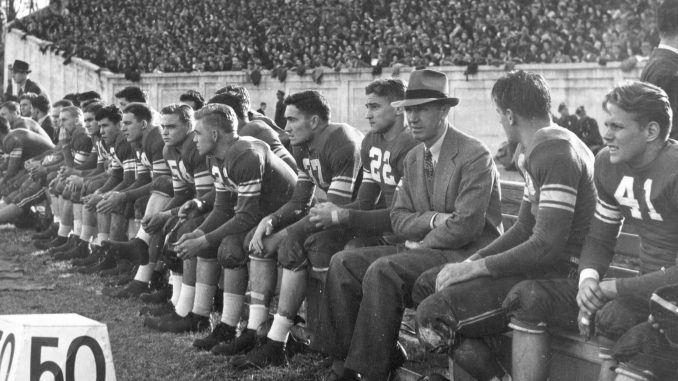
Growing up a son of the Greatest Generation around many men who served in World War II, Memorial Day sparks vivid memories of hearing their acts of bravery and sacrifice, which always begs the question of why they did it and would they do it again if asked today.
None are more memorable than hearing firsthand about legendary Duke football coach Wallace Wade, who coached my father from 1936-39 and remained a close family friend for the rest of his life. Coach Wade grew up on a farm in relatively humble circumstances in Trenton, Tennessee, about a half century after the Civil War, and earned a football scholarship to Brown University, where he was a lineman on their 1916 Rose Bowl team. He went on to coach at Alabama and won three national championships in the 1920s — firmly establishing the Crimson Tide as the football powerhouse it still is today.
In 1931, he became head coach at Duke University and took the Blue Devils to two Rose Bowls in the next decade. Coach Wade was the Nick Saban of his time and had the college football world at his hand.
Duke was selected to play Oregon State in the 1942 Rose Bowl. After Japan attacked Pearl Harbor on Dec. 7, 1941, game organizers considered cancellation for security reasons, but Coach Wade persuaded them to move it to Durham.
About two weeks after the Durham Rose Bowl, Coach Wade enlisted in the Army, along with many of the much-younger players from both teams, without a lot of fanfare. He was 50 years old.
Coach Wade told a sportswriter later in life the most disappointing day of his life was not being allowed on the first wave of invasion at Normandy in 1944 due to his age. His worst day had nothing to do with football.
What was inside of Coach Wade which led him to volunteer for active duty at age 50 when there was no chance of him being drafted?
Memorial Day is not just a time to remember those who have served us in the military but to remember the right reasons why they served and protected us as a nation. Learning about the patriotism of men such as Coach Wade gives us those reasons and should help shape our vision for what we should want not only in our military personnel but in our elected leaders and in ourselves, as well.
Coach Wade and others who served with him would say they were “defending our freedom,” which might be considered a bromide unless we examine what it meant to them in its deepest context.
Most of the world in 1942 was not yet fully aware of the great atrocities being committed against Jews by Adolf Hitler or the brutality of the Japanese army against the people of Southeast Asia. American soldiers such as Coach Wade enlisted to fight for something about America they felt deep in their bones, or else they wouldn’t have enlisted.
Coach Wade and others recognized the still-young nation of America, at 153 years of existence, was the last best hope for free people to govern themselves and not be subject to the whims and capricious decisions, often evil and wicked, of a few people or a single ruler. It still is today.
There was the promise of equality and opportunity for each person to make as much of this life as they could possibly achieve. Being a product of such opportunity himself to go from humble beginnings through the Depression to the top of the coaching profession, Coach Wade must have felt it was his duty to do whatever he could to make sure every American citizen had the chance to pursue their own dreams before America — and Western civilization — was snuffed out by a murdering megalomaniac such as Hitler and his fellow Nazis or the expansionist Japanese empire.
We have many threats facing us today, but none is more dire than the dangerous thought fostered by many on the progressive far-left that the idea of a free America is evil and not exceptional in any regard.
Would a Coach Wade of today feel compelled to volunteer for duty if the progressive left was fully in power and crushed free speech of conservatives, closed churches during epidemics, and celebrated the use of violence to destroy property and harm other people during so-called peaceful demonstrations? They would have a hard time arguing their case in front of a man such as Coach Wade, who not only believed America was special but put his life in harm’s way to protect it.