Seemingly unrelated story number one: Growing up, every summer, the carnival would come to town. My favorite game was the ring toss. One dollar got you 10 plastic rings, and you had to stand behind a waist-high wooden barrier—no leaning—and toss the rings, trying to hang one around the neck of the dozen bottles arranged in a grid on the other side of the barrier. If you succeeded, you won a stuffed animal and the admiration of onlookers.
One year, my friends and I thought about it and had a strategy we were fairly confident would hack ring toss. Instead of aiming each ring and trying to toss it at a specific bottle, one at a time, we reasoned, it would be better to throw them all at once. They would spread out, cover a wide area, and the odds of one of them finding the neck of a bottle would increase.
Try it. You’ll see. Our test runs were wildly successful. It’s why so many lotteries are won by groups of coworkers that pool your money. The more long shots you have, the better the odds that one will pay off.
That July, we showed up at ring toss, ready to rake in the prizes, only to see the small sign posted just below the stuffed animals hanging from the top of the booth. “Must throw one ring at a time.”
The carnies had already hacked the game, and made sure we couldn’t increase our already miniscule odds of success.
Seemingly unrelated story number two: In 2007, Gardner-Webb was invited to participate in the 2K Sports Coaches vs. Cancer Classic—one of those November tournaments now called MTEs. The first couple games were on campus sites, then the winners advanced to Madison Square Garden for the nationally televised final two rounds.
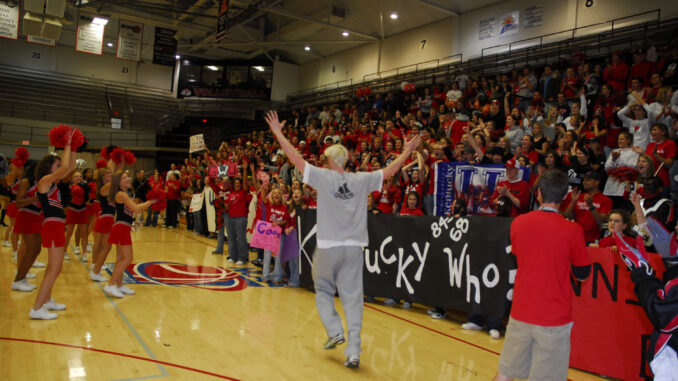
G-W opened play at Rupp Arena, against Kentucky. The Runnin’ Bulldogs pulled off an 84-68 upset of the blue blood Wildcats and were headed to the Big Apple and ESPN—instead of Kentucky.
A short time later, most MTEs changed their rules. The opening on-campus rounds were no longer elimination games. The host teams would be the ones advancing to the nationally televised championship rounds. For instance, in the 2011 Maui Invitational, when Middle Tennessee upset UCLA in an on-campus game in Los Angeles, the victorious MTSU was sent to Murfreesboro to compete in the “Regional Round”, while the losing Bruins went on to Maui.
People want to see blue bloods, and on-court results shouldn’t get in the way of TV-friendly matchups.
Seemingly unrelated story number three: The NCAA Tournament is expanding, from 68 teams to 76. Instead of four teams playing in Dayton for two spots as 16 seeds and another four playing for two No. 11 seed spots, a total of 24 teams will go to Dayton—and possibly another location to handle so many extra games. Murfreesboro might be a good choice.
Eight teams will have to win to enter the field of 64 as 16 seeds. Half of the 15 seeds will have to play their way in. The bottom eight at large teams will play to be the four 12 seeds, and four teams will battle for half of the 11-seed lines.
The NCAA web site assures everyone that, after those games are done, it will be the same as ever. No major changes. The explainer on the change includes the phrases “the traditional First Round rhythm remains intact,” and “without significantly altering the schedule fans have loved for years” and “The rest of the tournament schedule remains unchanged” and “retain(s) the same format.”
They really want you to know that this change won’t do anything significant.
Unless, of course, you’re Gardner-Webb or Middle Tennessee, or a kid with a handful of rings and a plan.
Tucked into the NCAA’s “nothing to see here” page is the following statement about the new opening round games: “Half of those games will feature the 12 lowest-seeded automatic qualifiers on the committee’s overall seed list. The other half will feature the 12 lowest-seeded at-large teams selected to the field.”
That’s true. Except the number of automatic qualifiers doesn’t change. So all of the new teams added to the tournament will be at large bids. That means those bracketology reports in early March that list the “first four out” and “next four out”? All eight of those teams are now in.
It also means that, instead of four teams from single-bid leagues having to play off to reach that unchanged round of 64, 12 will—a threefold increase. There were 24 single-bid leagues in the 2026 tournament. So half of them will now be relegated to the play-in round.
And when that completely unchanged round of 64 tips off, instead of having 22 teams from single-bid leagues and 42 power conference teams in the field, there will now be 18 single-bids and 46 power conferences.
So, the NCAA increased the tournament field by and reduced round of 64 opportunities for non-power conference teams by 18%.
It doesn’t just affect the single-bid teams relegated to the opening games. Automatic bid winners from small and mid-major leagues that were assigned to the round of 64 will now be seeded lower. Don’t believe it? Look at the West and South regionals from this year’s tournament. The top 10 teams in the South and top 11 in the West were all at large teams. The rest of the bracket were the automatic bid winners. With more at larges in the field, it’s doubtful they’ll take up 13 and 14 seeds. Instead, a VCU or Loyola of Chicago that once would have been an 11 is now a 13 or 14.
The expansion is the Gardner-Webb rule taken to the extreme. Groups of coworkers can still pool their money and buy lottery tickets, but only a couple.
It’s like adding one foot of water to a swimming pool. The swimmers in the deep end don’t notice. The kids in the shallow end sure do. The chances for upsets will be greatly reduced. The good news is that you’ll probably know the names of most of the teams you’re watching. Because all the little guys already tossed their one ring and watched it clang to the ground, while the power conferences divided up all the stuffed animals.
Remember: No leaning.