RALEIGH — North Carolina’s top Republican legislative leaders said Tuesday they have reached a framework agreement to break a nearly yearlong budget impasse, announcing plans for the largest average teacher pay raise in nearly two decades, double-digit salary increases for most law enforcement officers and a new schedule of personal income tax cuts.
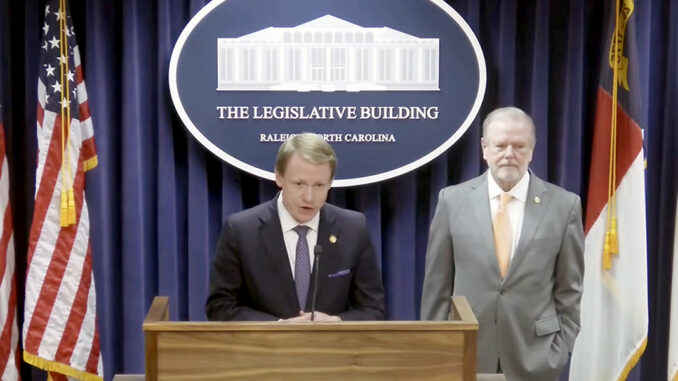
Senate leader Phil Berger (R-Eden) and House Speaker Destin Hall (R-Granite Falls) held a joint news conference announcing they had resolved the biggest structural disputes that have stalled negotiations between the two chambers.
“This is a starting point,” said Berger, who lost his reelection bid in the Republican primary to Rockingham County Sheriff Sam Page in March. “There’s still a lot that will need to be decided and discussed between the two chambers, but this agreement sets out a good framework for us to move forward.”
The centerpiece on the spending side is an 8% average pay raise for teachers, which leaders said would push starting teacher pay to first in the South when counted with local supplements while also lifting veteran teachers across the salary schedule.
“This budget is really an unprecedented one for education in this state,” said Hall, calling it the largest average teacher pay increase since at least 2006.
Teachers with more than 16 years of experience would receive a $1,000 bonus; less experienced teachers would receive $500.
State employees would see an average 3% raise, with bonuses of $1,750 for those earning less than $65,000 and $1,000 for those above that threshold. State retirees would receive a 2.5% bonus.
The agreement reserves the largest percentage increases for sworn law enforcement. SBI and ALE officers would receive an average 20.3% raise including step increases, State Highway Patrol officers 17.7%, correctional officers 15.4%, and probation and parole officers 10.1%. Other state government law enforcement officers would receive 13%. The budget also dedicates roughly $40.1 million for $1,750 one-time bonuses for local officers.
“It’s apt that this week is National Police Week because we’re able to deliver for the men and women who put their lives on the line to protect us every day,” Berger said.
The agreement would also repeal the existing personal income tax rate triggers in favor of a fixed schedule. The current 3.99% rate would drop to 3.49% in 2027, 3.24% in 2030 and 2.99% in 2033. Two further triggered step-downs would eventually take the rate to 2.49%. Both chambers also agreed to place a constitutional amendment on the November ballot lowering the state’s income tax cap to 3.5% and to pass a House-backed levy limit on property taxes.
“The business climate and our business environment has been created in large measure by our tax reduction strategies, and we intend to continue to see that going forward,” Berger said.
Overall spending is projected to grow about 7% across the biennium, or roughly 3.5% per year. Negotiators also agreed to release previously appropriated funds for the N.C. Children’s Hospital, bringing the total dedicated commitment to $208 million.