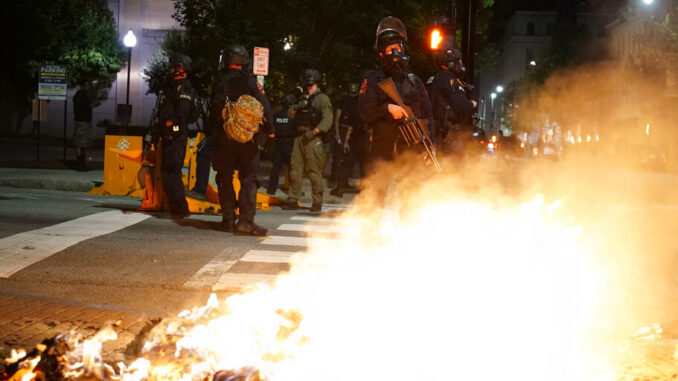
RALEIGH — Protesting, chanting and marching. Property damage, arson and rioting. This was the oscillating pattern in downtown Raleigh over the weekend of May 30 to June 1 in 2020 following the death of George Floyd.
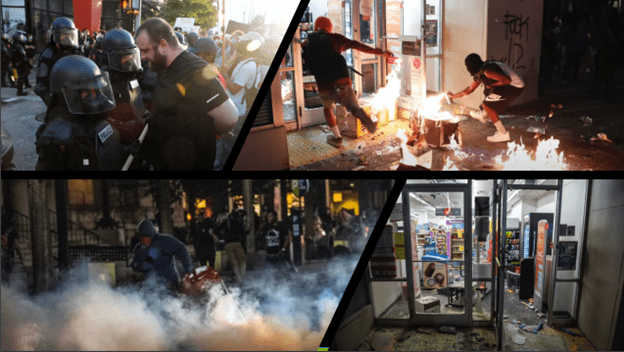
Each night, the protests gave way to riots, with businesses and government buildings damaged and looted, public property vandalized and arson, including a drugstore set ablaze.
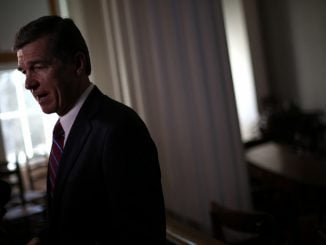
North State Journal (NSJ) has learned from former law enforcement officers who were in Raleigh helping to quell the rioting that then-Gov. Roy Cooper was evacuated from the Executive Mansion to outside the city during the unrest.
The officers, including former members of the North Carolina State Highway Patrol (NCSHP), spoke to NSJ under the condition of maintaining their anonymity due to fear of reprisal for themselves, their families and fellow law enforcement.
The evacuation
Former members of law enforcement told NSJ that sometime between 6 p.m. and 8 p.m. on May 31, Cooper and his family were evacuated from the mansion via a side portico entrance.
The Coopers were taken to the Emergency Management Operations Center (EMOC) located outside the 440 Beltline on Gold Star Drive, just off Blue Ridge Road, about 6½ miles from the Executive Mansion.
One former officer said a team was tasked with following Cooper’s motorcade to the EMOC and, once there, the team turned around and went back to aid Raleigh Police. The officer also said Cooper “had to know what was going on” in downtown Raleigh because key leadership for various law enforcement agencies were also at the EMOC.
Attempts to gain access to records of Cooper’s movements that night, such as travel logs, memos and emails related to that evacuation, have failed, with the NCSHP refusing to release any documentation.
“If any logs had existed, we would treat them as sensitive public security information under NCGS 132-1.7 and therefore not consider those documents to be a public record,” a public information officer for the NCSHP said in an email. It is the same response NSJ received when making a similar inquiry in 2020.
Additionally, NSJ sought other official records, including emails and relevant documents, from Cooper’s tenure. However, the State Archives of North Carolina claims Cooper’s papers are not yet in their possession nearly a year and a half after leaving office.
Weekend of riots: May 30-31, 2020
Between 500 and 1,000 people were estimated to have gathered in the downtown Raleigh area on May 30, 2020, to protest, and skirmishes with police began by early that evening.
Earlier that day, at 2:51 p.m., Cooper — who is currently campaigning against Republican Michael Whatley to succeed Thom Tillis in the U.S. Senate — issued a signed post on social media about Floyd, signing it “-RC.”
“George Floyd and so many others should be alive right now. People are angry, frustrated and sad, and I am too. If we don’t force our communities toward accountability and action then we haven’t learned anything,” Cooper wrote. “The protests around the country offer a space for people to make their voices heard, but they must happen without violence and further loss of life. It’s time we have the difficult conversations needed to stamp out racism and end these unjust killings. – RC.”
Cooper wasn’t heard from again until nearly 10 hours later when he issued a statement on social media.
“I am in continuing contact with Emergency Management leaders about violence occurring in some of our cities,” Cooper posted. “Frustrating that planned peaceful protests about real systemic racism are marred. I am grateful for those seeking justice peacefully. – RC”
A former officer confirmed to NSJ that protesters had approached the area of the governor’s mansion on the night of May 31 and were observed throwing objects, including water bottles and bricks.
Former NCSHP members on duty that night said they were ordered to split off from assisting Raleigh Police and were diverted on foot to intervene at the Executive Mansion because the law enforcement presence at the mansion was “worried they were going to be overrun.”
Officers also told NSJ they were deployed to assist Raleigh Police and restocked the police who had “expended most of their munitions.”
Another former NCSHP member said during those two nights in May, they deployed more chemical munitions than in the department’s history, which goes back to 1929. That officer confirmed shots were fired at them near the Capitol building, calling the scene “absolute chaos.”
More silence, protester praise
Cooper next posted at 4 p.m. on May 31, when he held a pandemic briefing, broadcast from the EMOC. His remarks focusing on Floyd protests and the rioting were captured in a separate video posted to the governor’s official YouTube channel. In part, Cooper expressed disappointment that media coverage had focused on the riots.
“Unfortunately, today the headlines are not about those protestors and their calls for serious, meaningful change,” Cooper said. “They are more about riots, and tear gas, and broken windows, and stolen property. That’s wrong and must be stopped. But I fear the cry of the people is being drowned out by the noise of riots.
“Let me be clear. People are more important than property. Black lives do matter.”
By the afternoon of May 31, then-Raleigh Mayor Mary-Ann Baldwin had signed a state of emergency declaration giving her the ability to request the National Guard, but a city spokesperson indicated she had not yet opted to do so.
Earlier in the day, then-Raleigh Police Chief Cassandra Deck-Brown held a press conference about the riots that took place the night before. At that time, Deck-Brown said their plan on Saturday night did not include requesting National Guard assistance.
In a separate statement, Cooper acknowledged mayors of several cities, including Raleigh, had requested National Guard support. As governor, Cooper had the power to send in the National Guard himself.
A statement issued by the North Carolina National Guard said Cooper had “authorized 450” guard troops on May 31. Official video and photographs located by NSJ depict about 100 NC National Guard troops being deployed on the evening of May 31 to Raleigh, mainly to the area around North Carolina Supreme Court building.
Marching with protesters
It is unclear exactly when Cooper returned to the Executive Mansion from the EMOC, but he was next seen in person on June 1 prior to rioting returning to the streets of Raleigh for a third night.
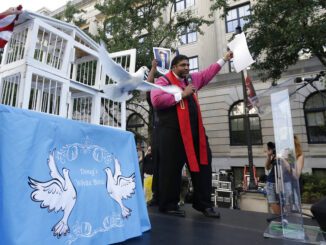
That afternoon, Cooper, in violation of his own executive orders on masking and social distancing, marched in front of the Executive Mansion alongside Black Lives Matter protesters. He was seen with his mask off, raising a fist and waving, as he walked from one of the gated entrances of the mansion to the other, flanked by members of his security detail.
One former law enforcement officer said Cooper’s march put officers in danger.
“(Cooper) decided to come out of the mansion, putting his detail at risk, our guys at risk, because he wanted to show he was a man of the people,” the officer told NSJ.
That officer also said it was a “photo op” for the cameras to see him “with his mask off in all his smirking glory” outside the governor’s mansion.
Prior to his June 1 news briefing and his solidarity march with the protesters, Cooper allegedly met privately with protest organizers, one of which was Conrad James of Living Ultra-Violet.
James has a criminal record in Wake County of 13 arrests going back to 2012, six of which occurred after the 2020 protest. Those include an arrest for felony incitement to riot 20 days after allegedly meeting with Cooper.
Records show James was charged with felony incitement of a riot two more times, in October 2021 and February 2023. James’ Facebook profile as of May says he now lives in Anchorage, Alaska.
Moore: ‘It was like Grand Theft Auto’
After hours of rioting had stretched into the early hours of May 31, state House Speaker Tim Moore (R-Kings Mountain) watched the chaos unfold from his apartment balcony and streamed video of the rioting on his Facebook page.
“I am witnessing utter lawlessness firsthand in downtown Raleigh,” Moore, who is now a congressman, said in an accompanying Facebook post. “The senseless destruction of businesses and property must be stopped at once. I am calling on Governor Cooper to immediately send in the National Guard. As I am posting this I literally am hearing semi-automatic gunfire, hearing glass windows being smashed and shouts from rioters. Unbelievable this has not been stopped.”
Moore’s claim of hearing gunfire was corroborated by one of the former NCSHP officers, who told NSJ shots were fired at them that evening near the old Capitol Building, which is the official office of the governor.
Moore posted another video of the aftermath to his Facebook page, noting, “Hundreds of volunteers are in downtown Raleigh helping local residents and employees clean up buildings destroyed in last night’s riots.”
In a formal statement that followed, Moore said he had “urged the Governor directly by text message Saturday night to deploy the National Guard to downtown Raleigh, while witnessing and filming rioters set fires and shatter windows of resident buildings and businesses.”
This past March, NSJ asked Moore about that text message to Cooper, and he recalled sending a text and a voicemail but said Cooper did not reply for “a couple of days.”
“But I was upset because I had discovered through — and I can’t remember through which law enforcement agency — that the National Guard were staged in North Hills,” Moore said. “I was told that the governor had told them not to come downtown, not to deal with the rioters. And to this day, I’m shocked that that happened.”
An inquiry made by NSJ to the North Carolina National Guard on its deployment orders that weekend was not fully responded to by publication time. A spokesperson did say the Guard was available, having already been activated related to the COVID-19 pandemic.
Moore described rioters trying to set fire to a nearby Dollar General store and said it crossed his mind several times that there were people living above that location, some of them elderly.
“What do I do if these fools start burning this building?” Moore said he wondered at the time.
Richard Rubalcava was arrested and federally convicted for trying to set fire to the Dollar General. He was also accused of looting and attempting to set multiple other fires in Raleigh on May 30. He gets out of prison in September.
Rubalcava took a plea deal in the case. In 2024, he was serving a seven-year sentence in a high-security federal prison in Victorville, California, with a release date of Aug. 5, 2026. Federal prison records now show Rubalcava as still incarcerated but in Virginia’s Petersburg Medium FCI with a new projected release date of Sept. 15, 2026.
Moore said if arrests had happened early on, maybe the rioting could have been quelled.
“But they just let it go … and it just fed on itself,” he said.
“And you could watch it. I mean, once the windows were shattered, then they started wanting to burn things. You could hear gunshots. There were people driving cars down through there. It was like that video game Grand Theft Auto just came to life right there in real time. It was insane.”
Moore said what happened in Raleigh was “just shameful,” noting the businesses attacked those nights were already struggling due to Cooper’s pandemic shutdown orders.
“The governor kept North Carolina closed, and in the legislature we didn’t have a supermajority, so we couldn’t do anything to force anything open. So we were powerless,” said Moore. “I mean, it was just a real, real sad chapter in our state’s history, and I do think that the governor failed miserably in his job on that.”
He went on to add that despite the police presence, “the governor never did use the full resources that were available to protect the people at the property of Raleigh.”
“And I think it was an absolute disgraceful failure of leadership that is just not excusable,” added Moore.
Moore said he fielded “a lot of calls” from people in different agencies who were “just beside themselves” when they saw the footage of Cooper marching with the protesters.
A member of Cooper’s past security detail who did not wish to be identified echoed what Moore said, saying he had “always been apolitical” on the job, but when Cooper marched with the protesters, “I was just done.”
A request for comment, including additional questions, was sent to the Cooper campaign. A response was not received by publication time.