
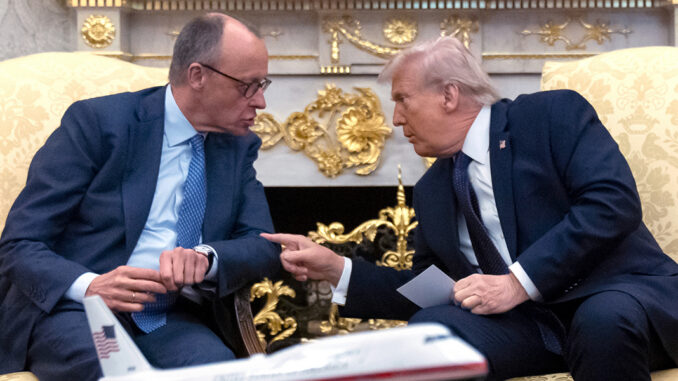
WEST PALM BEACH, Fla. — President Donald Trump said last week that the U.S. will significantly reduce its troop presence in Germany, escalating a dispute with Chancellor Friedrich Merz as he seeks to scale back America’s commitment to European security.
The Pentagon had initially announced it would pull some 5,000 troops out of Germany, but when asked about the reason for the move, Trump didn’t offer an explanation and said an even bigger reduction was coming.
“We’re going to cut way down. And we’re cutting a lot further than 5,000,” Trump told reporters in Florida.
Earlier last Saturday, Germany’s defense minister appeared to take in stride the news that 5,000 U.S. troops would be leaving his country.
Boris Pistorius said the drawdown, which Trump has threatened for years, was expected, and he said European nations needed to take on more responsibility for their own defense. But he also emphasized that security cooperation benefited both sides of the trans-Atlantic partnership.
“The presence of American soldiers in Europe, and especially in Germany, is in our interest and in the interest of the U.S.,” Pistorius told the German news agency dpa.
The planned withdrawal faced bipartisan resistance in Washington, with swift criticism from Democrats and concern from Republicans that it would send the “wrong signal” to Russian President Vladimir Putin, whose full-scale invasion of Ukraine recently entered its fifth year.
Trump’s decision comes as he seethes at European allies over their unwillingness to join his campaign with Israel against Iran. He has lashed out at leaders like Merz, Spanish Prime Minister Pedro Sánchez and British Prime Minister Keir Starmer.
Merz last week criticized the war in Iran, saying the U.S. is being “humiliated” by the Iranian leadership and calling out Washington’s lack of strategy.
In another sign of friction, Trump accused the European Union of not complying with its U.S. trade deal and announced plans to increase tariffs next week on cars and trucks produced in the bloc to 25%, a move that would be particularly damaging to Germany, a major automobile manufacturer.
At least one EU lawmaker called the tariff hike “unacceptable” and accused Trump of breaking yet another U.S. commitment on trade.
A pullout of 5,000 soldiers from Germany would amount to about one-seventh of the 36,000 American service members stationed in the country. The Pentagon offered few details about which troops or operations would be affected. When contacted after Trump’s announcement of more cuts last Saturday, the Pentagon did not offer any additional details and referred back to its earlier statement.
The withdrawal of the 5,000 troops is scheduled to take place over the next six to 12 months, according to the Pentagon. Trump previously said he would pull 9,500 troops from Germany during his first term, but he didn’t start the process, and Democratic President Joe Biden formally stopped the planned withdrawal soon after taking office in 2021.
More broadly, about 80,000-100,000 U.S. personnel are usually stationed in Europe — depending on operations, exercises and troop rotations. The U.S. increased its European deployment after Russia launched its full-scale war on Ukraine in February 2022. NATO allies like Germany have expected for more than a year that these troops would be the first to leave.
NATO spokesperson Allison Hart, in a post last Saturday on X, said the trans-Atlantic alliance was “working with the U.S. to understand the details of their decision on force posture in Germany.”
“This adjustment underscores the need for Europe to continue to invest more in defense and take on a greater share of the responsibility for our shared security,” she added, noting “progress” toward a target among NATO allies to each invest 5% of their economic output to defense.


