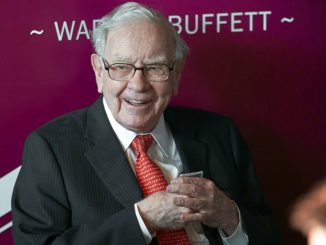
OMAHA, Neb. — Warren Buffett’s company reported less than half as much profit in the second quarter as it took a $3.76 billion write-down on the value of its stake in Kraft Heinz, as that iconic food producer considers largely undoing the merger that Berkshire Hathaway helped bankroll.
Berkshire said it earned $12.37 billion, or $8,601 per Class A share, during the quarter. That’s down from $30.248 billion, or $21,122 per Class A share, a year ago because it recorded a much smaller paper investment gain this year.
Berkshire’s earnings can swing wildly from quarter to quarter because it has to record the current value of its massive investment portfolio even though it doesn’t sell most of the stocks. That’s why Buffett has long recommended that investors pay more attention to Berkshire’s operating earnings, which exclude those investment gains. Although last year Berkshire surprised shareholders by selling off a huge chunk of its Apple stake, which inflated the investment gains.
By that measure, Berkshire’s operating earnings were only down slightly at $11.16 billion, or $7,759.58 per Class A share. That compares with $11.598 billion, or $8,072.16 per Class A share, a year ago. Most of Berkshire’s myriad assortment of companies — major insurers like Geico, BNSF railroad, a group of utilities, and a collection of manufacturing and retail businesses — generally performed well despite the economic uncertainty and President Donald Trump’s tariffs.
The four analysts surveyed by FactSet Research expected Berkshire to report earnings per Class A share of $7,508.10, so the Omaha, Nebraska-based conglomerate’s results were ahead of that.
Berkshire owns more than 27% of Kraft Heinz’ stock. For years, it had representatives on the company’s board. Buffett has said previously he believes the company’s iconic brands will do well over time, but in hindsight, he overpaid for the investment and underestimated the challenges branded foods face from retailers and the growth of private label products.
This spring, Berkshire’s representatives resigned from the Kraft Heinz board shortly before the company announced it was exploring strategic options that may include spinning off a large part of its portfolio of brands.
Over the years since Berkshire helped Kraft buy Heinz in 2015, the company has been hurt by changing consumer tastes and a shift toward healthier options than Kraft’s core collection of processed foods.
Another write-down could be coming because CFRA Research analyst Cathy Seifert pointed out that Berkshire’s holding of 28% of Occidental Petroleum’s stock, which is currently valued at about $5.3 billion less than the $16.5 billion Buffett paid for it.
Buffett’s is still sitting on a massive pile of $344.1 billion in cash, although the company’s reserves dipped slightly from the $347.7 billion cash it was holding at the end of the first quarter. Buffett told shareholders in May he isn’t finding any attractive deals for companies he understands.
Buffett surprised shareholders at the annual meeting when he announced he plans to give up the CEO title at the end of the year and hand over operations to Vice Chairman Greg Abel. Buffett will remain chairman.
Berkshire shareholders might be disappointed the company didn’t repurchase any of its shares this quarter, even though the price has fallen more than 12% since just before Buffett announced his retirement. But investor Chris Ballard, managing director at Check Capital, said he wasn’t surprised at the lack of buybacks because even after the recent drop, Berkshire’s stock is still selling at a premium compared to the value of its businesses.
Many investors are watching Berkshire’s BNSF closely after rival Union Pacific announced a plan to buy Norfolk Southern earlier this week to create the nation’s first transcontinental railroad. The speculation is that BNSF needs to pursue a merger with eastern rail CSX to be able to compete.
But Seifert said it isn’t Buffett’s style to jump into a deal just because the market thinks he should. Over the decades, he has built Berkshire by finding strong companies selling for less than they are worth. CSX is trading near its 52-week high at $35.01 amid all the deal speculation.
“He wants to do it because he found an undervalued franchise, not because the market says you need to do a deal,” Seifert said. “I think one of the reasons why that cash hasn’t been deployed is that valuations run through the Berkshire M-and-A model tend to be too rich. But if there’s a logical case to be made, they’ll accept it.”