April 30
1789: George Washington inauguration 1789 — George Washington took the oath of office at Federal Hall in New York as the first president of the United States.
1803: The United States completed the Louisiana Purchase, acquiring 828,000 square miles from France for 60 million francs (about $15 million), roughly doubling the nation’s size.
1975: The Fall of Saigon marked the end of the Vietnam War as the South Vietnamese capital of Saigon fell to Communist forces.
May 1
1960: The U-2 incident occurred when the Soviet Union shot down an American U-2 reconnaissance plane and captured its pilot, Francis Gary Powers.
1963: Jim Whittaker, joined by Sherpa mountaineer Nawang Gombu, became the first American to summit Mount Everest.
2011: President Barack Obama announced the death of Osama bin Laden.
May 2
1863: During the American Civil War, Confederate Gen. Thomas “Stonewall” Jackson was accidentally wounded by his own men at Battle of Chancellorsville; he died eight days later.
1927: In Buck v. Bell, the U.S. Supreme Court upheld, 8-1, a Virginia law allowing the forced sterilization of people to promote the “health of the patient and the welfare of society.”
1994: Nelson Mandela claimed victory for the African National Congress.
May 3
1802: Washington, D.C. was incorporated as a city.
1937: Margaret Mitchell won the Pulitzer Prize for her novel “Gone with the Wind.”
1948: The U.S. Supreme Court, in Shelley v. Kraemer, ruled that racially restrictive housing covenants were legally unenforceable.
May 4
1886: A labor rally at Haymarket Square in Chicago turned deadly when a bomb exploded, killing seven police officers and at least four civilians.
1904: The United States took over construction of the Panama Canal from France.
1961: The first group of Freedom Riders departed Washington, D.C. to challenge segregation on interstate buses and in terminals.
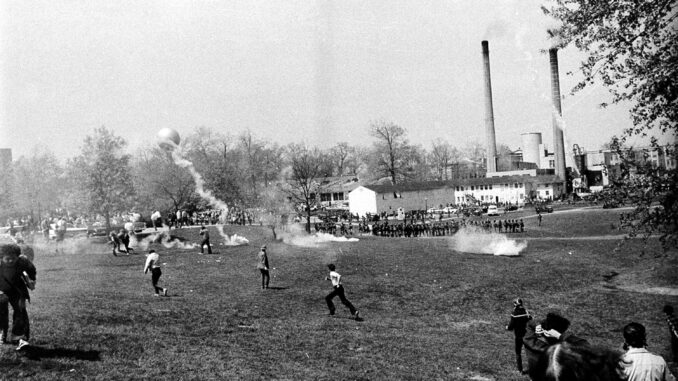
1970: Ohio National Guardsmen opened fire on student demonstrators at Kent State University, killing four and wounding nine in an anti-war protest.
May 5
1821: Napoleon Bonaparte, 51, died in exile on the South Atlantic island of Saint Helena.
1925: High school teacher John T. Scopes was charged in Tennessee with violating a state law banning the teaching of evolution; he was later found guilty, though the conviction was set aside.
1973: Secretariat won the Kentucky Derby in 1:59.4, the first of his Triple Crown victories and a record that still stands.
May 6
1889: The Eiffel Tower opened to the public as part of the Paris World’s Fair.
1935: The Works Progress Administration was established by executive order signed by President Franklin D. Roosevelt.
1937: The German airship Hindenburg caught fire and crashed while attempting to dock at Lakehurst, killing 35 of the 97 people on board and one crew member on the ground.