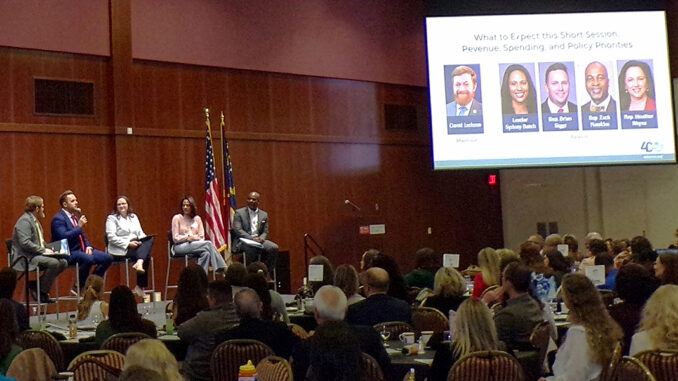
RALEIGH — The Public School Forum of North Carolina held its annual Eggs & Issues event at the McKimmon Center on the NC State campus last Tuesday.
Most of the forum’s top issues from the past two years carried over to this year’s event, such as raising teacher pay, “fully funding” state K-12 education, revamping the A-F school accountability model, and addressing “whole child” needs both in and outside of school.
The event also featured commentary on the recent Leandro education funding decision by the North Carolina Supreme Court, which reversed its previous ruling by confirming the legislature controls the purse under the state’s constitution.
“This lawsuit has never ever had anything to do with politics,” Bill Harrison, the forum’s chairman, said. “It has always had everything to do with doing right by all kids.”
Harrison was the superintendent of Hoke County Schools when the case was first filed 32 years ago. Ann McColl, a recent director for the forum, called the ruling “nonsense” and said, “We should take it for what it is — a political decision.”
One panel discussion featured four legislators: Reps. Brian Biggs (R-Randolph), Heather Rhyne (R-Forsyth) and Zack Hawkins (D-Durham), and Sen. Minority Leader Sydney Batch (D-Wake).
Moderator David Jackson, president and CEO of the Boone Chamber of Commerce, raised education funding, teacher pay, the state budget, property taxes, school vouchers and workforce issues ahead of the short legislative session as critical issues.
All the panelists described being public school graduates and emphasized supporting teachers and students, but they differed on priorities. Republicans focused on teacher raises, workforce programs and smart spending, while Democrats stressed the “fiscal cliff,” equity and criticized Republican leadership for not acting boldly enough on funding.
The conversation was mostly optimistic about getting the state budget done soon, with calls for bipartisanship, accountability and keeping students first.
“I can tell you from the House side, teacher pay is one of our biggest priorities,” Biggs, one of the House K-12 Education Committee chairs, said when asked what trade-offs might be considered to reach an agreement on the budget. “That’s one of the biggest priorities. And we want meaningful rates, not a 1 or 2%.”
He added, “Education, to me, is not something that you can trade off. It’s not something we can negotiate with. It’s something we’ve got to have.”
Rhyne was asked about her experience on the local school board and the House Select Committee on Property Tax Reduction and Reform related to the potential impact of proposed property tax changes on local school funding.
“Those conversations can lead to some great changes and to some great results,” said Rhyne. “Building those relationships with your county commissioners during this time is going to be extremely important to look at how you’re funded.”
Public School Forum’s interim president and CEO Lauren Fox said of the Opportunity Scholarship program (OSP), which gives tiered grants for students to attend the private school of their choice, that North Carolina “remains the state with the least accountability by a long shot.”
Rhyne countered that statement.
“First I’ll say, let me squash the rumor that there is zero accountability in Opportunity Scholarships,” said Rhyne. “Because there is a whole statute on that you can look at where there is testing and there is reporting requirements for schools that take students that have Opportunity Scholarships.
“From an Opportunity Scholarship standpoint, it’s the one that’s really bipartisan,” Rhyne said, citing polls showing more than 60% support the OSP. “And so, it really is a bipartisan effort to make sure that our kids are getting the education in an environment that they feel like they will thrive in.”
Hawkins said if people want to send their kids to private school, they should pay and not the state.
“Public dollars belong with public schools,” said Hawkins. “If you want to move towards a private education, you should want to pay for it.”
Batch was asked about how the Senate Democratic Caucus will be working to make sure everything education-wise is done from an equitable standpoint given possible revenue issue.
“My Senate Republican colleagues are engaging in magical thinking,” said Batch. “And the fact that they believe that we are not at a fiscal cliff and that we aren’t going to be in a situation where we’re going to end up at some point not having enough money to meet the needs of a state that’s rapidly growing.”
She then referred to Jay-Z for a quote, stating, “We got 99 problems. Money is almost all of them, y’all. … If you give the resources necessary to the school systems, that’s great.”
When asked about property tax priorities emerging at the General Assembly, Batch said, “I think they need to stay out of local property tax business. … You have to pick a lane.
“So if the legislature is going to go ahead and push for this property tax nonsense and say that there needs to be a cap, then my response is, well, then we need to step in, and we need to actually fill that void.”
At the close of the panel, all four lawmakers were asked to sum up the nearing short session in three-word predictions.
Biggs said, “It’s gonna be a long session,” while Rhyne replied, “Lots of opportunity.”
Batch said, “Politics will win,” and Hawkins couldn’t pick three words and said, “It will not be a short session at all.”