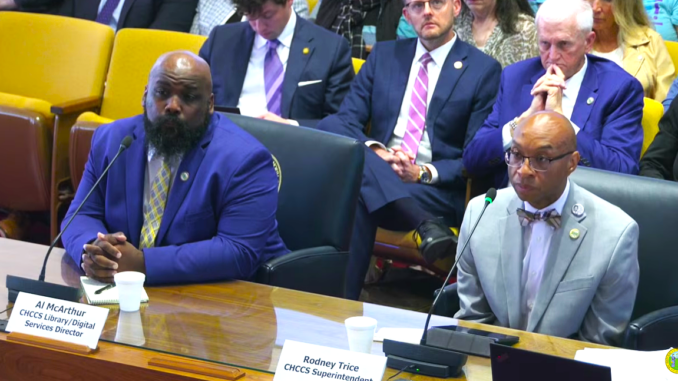
RALEIGH — For the second time in five months, the North Carolina House Oversight Committee summoned Chapel Hill-Carrboro City Schools Superintendent Rodney Trice to answer for alleged violations of the Parents’ Bill of Rights law.
While there was no tossing of books over one’s shoulder as there was during the December 2025 hearing, it was a tense, nearly three-hour hearing on Thursday.
Lawmakers also called in Chapel Hill-Carrboro City Schools’ (CHCCS) Library Director Al Arthur, who echoed Trice’s answers under questioning.
Republican lawmakers presented internal emails, guidance documents and library inventories they say prove the district has continued to sidestep the law’s requirements on parental notification for name and pronoun changes and the prohibition on sexually explicit and gender-identity materials for kindergarten through fourth grade.
“Nobody wanted this committee back here today with you,” Chairman Rep. Brenden Jones (R-Columbus) told Trice at the start of the proceedings. “We sat right here four months ago and asked you to do one simple thing: follow the law, follow Senate Bill 49, follow the Parents’ Bill of Rights. Comply fully, honestly, without games.”
Jones accused the district of gaslighting parents and the committee in December by claiming the controversial books were merely “third-party links,” only for investigators to later document “155 copies of 63 unique titles” on sexuality, gender identity and sexual activity sitting on the district’s elementary school shelves.
Multiple committee members felt CHCCS has and is still treating sections of the law as optional.
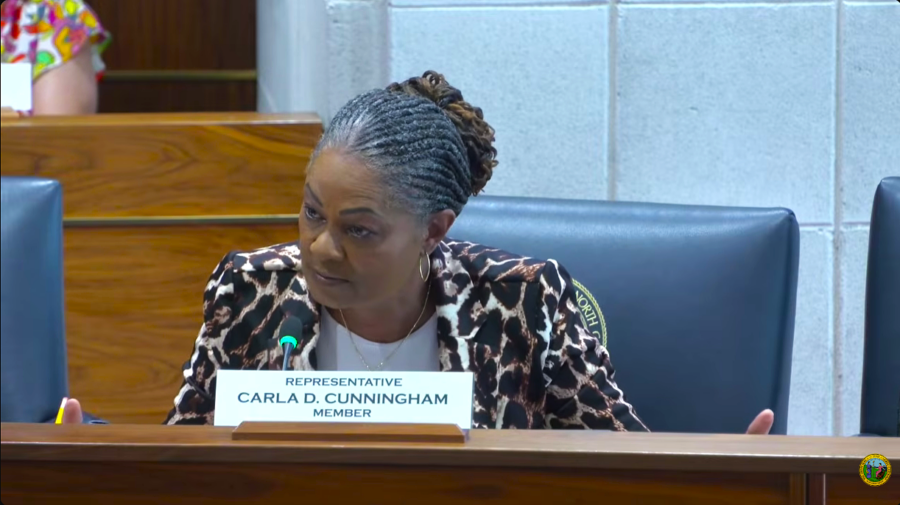
“If the statute passes and is written into the books, you must follow the law. It’s no way around it,” Rep. Carla Cunningham (D-Mecklenburg) told Trice. “It’s not about your emotions. It’s not about what people think is right or wrong.”
Rep. Mike Schietzelt (R-Wake) had a tense back and forth with Trice, asking how the district was distinguishing between library books and curriculum, and if there was a list showing that delineation. Trice replied, “No,” prompting Schietzelt to ask, “If you don’t distinguish between those, then how can the law distinguish between them?”
Schietzelt then got Trice to admit that literacy efforts were curriculum and library books were linked. Trice tried to object, but the Wake lawmaker cut him off.
“The problem here is that we’ve asked you questions about the application of the law, and a very fair and straightforward application of the law,” Schietzelt said. “And you two gentlemen have come in and tried to split hairs about how that law is supposed to apply by trying to distinguish between books that serve student interests and books that serve the curriculum.”
Rep. Grant Campbell (R-Cabarrus) focused on the district’s pre-2026 “guidance” written by Trice’s predecessor. The guidance told staff that if a student expressed concern about parental notification of pronoun or name changes, referred to as “familial strain,” then teachers were “not required to move forward with notifying the parent.”
Campbell pressed Trice repeatedly on whether this complied with S.B. 49’s clear mandate. Trice maintained the district has been compliant since 2023 and parents must be notified before any official change occurs.
Questioning by multiple lawmakers on the same topic highlighted the district relying on nonbinding guidance rather than formal board policy, allowing what lawmakers called “quiet walk-arounds” of the statute.
Campbell also confronted Trice on library content. He asked the superintendent, who was under oath, to agree that “materials that talk about sexuality, describing sexual acts, illustrating sexual acts, shouldn’t be in elementary school libraries.”
Trice refused, stating, “I’m not necessarily agreeing with that.”
“What I’m saying is that we trust the professionalism of our school librarians… to make the appropriate choices, age-appropriate choices for our children,” Trice added.
When pressed on a hypothetical about books depicting sexual acts, Trice repeatedly claimed their libraries “don’t have any resources that depict what you’re describing.”

Later in the hearing, Jones confronted Trice and Arthur with examples from books found in CHCCS elementary libraries. In particular, Jones showed Trice and Arthur an image from a book of two men dressed in bondage apparel kissing.
Trice said he didn’t understand what “the challenge is” and, while looking at the image, described what he saw was “a pride flag” and “community.”
The district’s equity website scrubbing was revisited. It was revealed that one day after the committee’s October 2025 letter to CHCCS, an equity office employee hid nine pages of its website, including LGBT resource and elementary resource pages, for 45 minutes.
Rep. Brian Echevarria (R-Cabarrus), questioning Trice, asked who told them to do that.
Trice called it an isolated action by a single employee trying to “lessen damage,” but Echevarria noted the timing, telling Trice only eight website updates had been made in the prior 15 months, yet 17 were made in one day after their letter arrived.
Rep. Amos Quick (D-Guilford) defended the district, calling Trice a “political punching bag” for a “flawed” law passed without educator input. Other Democratic members emphasized parent involvement and the district’s high performance while arguing libraries are voluntary spaces, not curriculum.
But Republicans continued their questioning on the district’s lack of compliance, with Co-Chair Rep. Jake Johnson (R- Polk) stating there appeared to be “a willful intent to subvert the intent of the law.”
Rep. Harry Warren (R-Rowan) and others reiterated that third-party links and library books still fall under S.B. 49’s restrictions on K-4 instruction.
Jones closed the hearing by announcing new legislation, titled the “CHCCS Act” which he said is designed to close the loopholes the district has been accused of exploiting.
The bill would require explicit parental consent before any name, pronoun or gender designation change in school records or by staff, and would expand on the current law’s ban on gender identity and sexuality topics through fourth grade.
Under the bill, parents would be able sue for violations, recovering $5,000 per violation plus attorneys’ fees after exhausting administrative remedies. Also included is a prohibition on the use of third-party resources, including websites, for K-4 unless provided directly by the district.
There are financial penalties in the bill, which creates a 45-day “cure period” for noncompliance, with potential withholding of funds tied to leadership salaries.
The bill also has more oversight in the form of General Assembly subpoena powers and allowing the state auditor to conduct investigations into noncompliance.
Jones emphasized that “compliance with state law is not voluntary” and warned there will be consequences for districts that treat it as such.