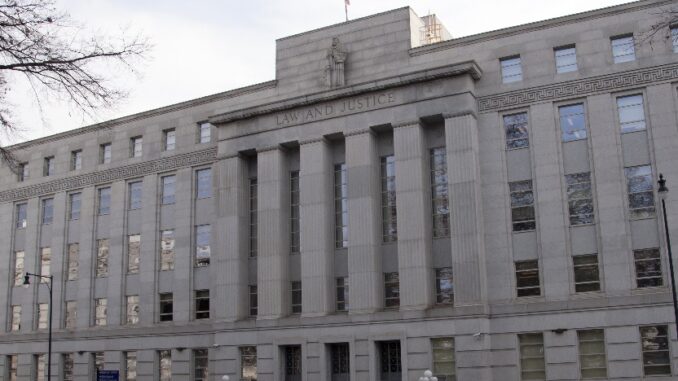
RALEIGH — The North Carolina Supreme Court reached a 4-3 decision Thursday in the long-running Leandro education lawsuit. The case was vacated and dismissed with prejudice, meaning it cannot be brought again.
The new ruling, issued by Chief Justice Paul Newby, essentially boils down two key issues: case jurisdiction and who controls appropriations in the state under the North Carolina Constitution.
The ruling says the trial court lost its jurisdiction to hear the case when it stopped being about the original narrow claims involving Hoke County and four other low-wealth districts and became a sprawling statewide lawsuit.
The court also said the lawsuit was never properly amended to make that new claim and wasn’t filed for hearing by a special three-judge panel that the law requires for statewide constitutional challenges.
The ruling says anything the trial court or the Supreme Court did after July 2017 is essentially void. That includes court’s own 2022 pro-plaintiff ruling (Hoke III) in the Leandro case that tried to force major changes, including funding, when the high court had a Democratic majority.
“By 24 July 2017, the remaining participants in the litigation and the trial court officially transformed this case into one addressing matters never pled,” wrote Newby. “Specifically, the trial court worked with the remaining parties in this case — while excluding the General Assembly — to enforce a statewide plan that overhauled the legislatively enacted educational system.
“What began as modest, as-applied challenges to the allocation of educational resources in the named school districts became a full-scale, facial assault on the entire educational system enacted by the General Assembly.”
Republican lawmakers who intervened in the case had argued the state constitution does not give the courts the power to make such appropriations as the 2022 Supreme Court had tried to do.
The now-majority Republican Supreme Court agreed, saying in Thursday’s ruling that judges lack authority to order the legislature to appropriate specific funds.
The funds in question go back to the West Ed Comprehensive Remedial Plan, a multibillion-dollar outline of an educational overhaul that was more than 300 pages long plus appendices.
WestEd’s plan had a huge dollar figure attached to it of around $8.29 billion in new state-level spending on schools over an eight-year period, with an expectation that the federal government would supply another $3.87 billion per year. Among the spending items was $400,000 per year for a state “Office of Equity Affairs.
Later, in 2023, the dollar figure would be “recalculated” down to $677.8 million. That adjustment took into consideration funds already put into education by legislative budgets.
Of the $2 million total paid for WestEd to produce the report, $1.5 million came from two agencies reporting to former Gov. Roy Cooper, as well as from several left-leaning groups, according to 2021 report by WRAL.
Democratic Associate Justices Anita Earls and Allison Riggs dissented, along with Republican Associate Justice Richard Dietz.
Earls argued in her more than 75-page dissent that the case has always been “about the nature of the constitutional right recognized three decades ago in Leandro v. State (Leandro I): that the State has a duty to guard and maintain the right of every North Carolina school child to access a sound basic education.” She added, “The Court today betrays these constitutional commitments.”
“Under the guise of a narrow subject matter jurisdiction question, the majority voids a decision from a prior composition of this Court with which it disagrees, undermines decades of precedent,” wrote Riggs.
In his dissent, Dietz wrote, “There is an incongruity in this case that is too obvious to ignore,” adding he disagreed “there are fatal jurisdictional defects in this case.”
The original plaintiffs
The original plaintiffs were five low-wealth, mostly rural county school districts. Led by Robb Leandro, the lawsuit’s namesake and former Hoke County student, the original lawsuit was filed in 1994 alleging that the state’s funding system left them unable to provide adequate educational opportunities due to low property wealth and despite raising local tax levels. In addition to Hoke County the other four school districts were Cumberland, Halifax, Robeson and Vance.
Early in the case, several larger and wealthier urban districts joined the case as plaintiff-intervenors. They argued that the funding system also failed to adequately support at-risk students in their districts, even if the districts had higher overall wealth.
The intervening districts included Asheville City Schools Buncombe County Schools, Charlotte-Mecklenburg Schools, Durham Public Schools, Wake County Public School System and Winston-Salem/Forsyth County Schools.
The case continued to wind its way through the court, and after 2017, the trial court and the parties turned the case into a statewide facial challenge that demanded an overhaul of the entire state education funding system for every district and school.
The General Assembly did not intervene initially, but that quickly changed after the 2022 Supreme Court ruling and subsequent trial court order for millions in funding — which they argued was in violation of the state constitution giving the legislature appropriations authority.
Reactions to the ruling
Demi Dowdy, spokesperson for NC House Speaker Destin Hall (R-Granite Falls), said in a statement, “Today’s decision rightly recognizes the constitutional role of the North Carolina General Assembly, since the state Constitution entrusts sole appropriations authority to the legislature.
“House Republicans remain committed to investing in public education, including through our budget proposal to raise starting teacher pay to $50,000 and provide 8.7% average raises to our public school teachers.”
Senate Leader Phil Berger (R-Eden) also weighed in.
“For decades, liberal education special interests have improperly tried to hijack North Carolina’s constitutional funding process in order to impose their policy preferences via judicial fiat,” Berger said. “Today’s decision confirms that the proper pathway for policymaking is the legislative process.
Berger said the state’s children today have “access to world-class educational opportunities because of the legislature’s commitment to improving educational outcomes.” He added Senate Republicans will continue to focus on increasing parental involvement and educational opportunities for students during the short session which starts this month.
Gov. Josh Stein’s statement said the four of the justices in the majority “are wrong.”
“Education opens doors of opportunity for children, but today the Court slammed them in the face of students who deserve the right to a sound basic public education,” Stein’s said.
He added the ruling “simply ignored its own established precedent, enabling the General Assembly to continue to deprive another generation of North Carolina students of the education promised by our Constitution.”
“Four Supreme Court justices believe that is okay, but they are wrong. Their decision is contrary to the plain language of our Constitution and the court’s past rulings.”