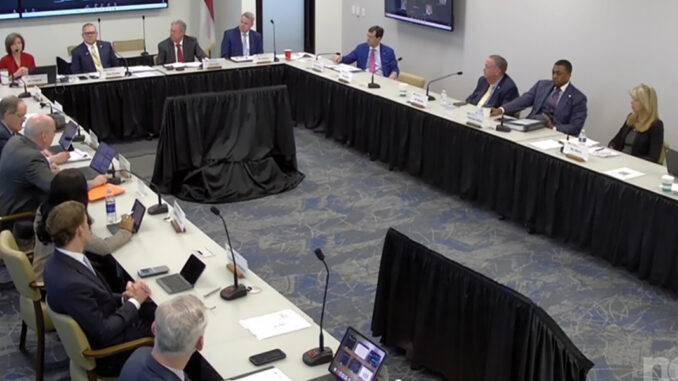
RALEIGH — The UNC Board of Governors met last week and approved two key items: a 3% tuition hike and a clear definition of academic freedom to be added to UNC System policies.
Board Chair Wendy Murphy said the decision will “allow for a raise in tuition for the first time in almost a decade is not a rubber stamp.”
The approval marks the first increase in tuition rates for the UNC System in nine years.
Murphy later said inflation driving up operation costs had been dealt with so far, but UNC System schools can’t be expected to continue “holding the line” without “negative impacts.”
The board gave its initial green light on a 3% in-state undergraduate tuition increase at its meeting in January, and the February vote made it official.
Of the 16 system schools, three have already signaled they will implement the increase: UNC Chapel Hill, NC Central and NC State. Most of the remaining schools are expected to follow suit, though perhaps not at the full 3%.
NC Promise program schools will keep the $500 per semester tuition rate for in-state students and will increase out-of-state nonresident tuition by $1,000 for 2026 to $3,500 per semester.
UNC Chapel Hill is also raising tuition 10% for nonresident undergraduates. That school’s 2025-26 tuition and fees for those students totaled $44,228, and the 10% increase would raise that to $48,650. The overall cost estimated for nonresident undergraduates to attend UNC Chapel Hill this past year was $64,846.
NC State is also raising tuition for nonresident undergraduates but at the same 3% as in-state students. This year’s tuition and fees for nonresident undergraduates at NC State were $33,993, and the 3% increase would bring that total up by $1,590 to $35,012. The overall cost to attend the school for nonresidents this year was $53,004.
The increase will not affect current students and will apply to incoming students for the next academic year.
Last November in a 6-5 vote, the UNC Chapel Hill Board of Trustees first approved a 3% tuition rate hike for in-state undergraduates and a 10% increase for out-of-state undergraduate students. The last time an out-of-state tuition increase was considered by the UNC System was 2020.
The academic freedom definition presented and voted on by the board states it is “the foundational principle that protects the rights of all faculty to engage in teaching, research/creative activities, service, and scholarly inquiry without undue influence.”
The definition goes on to state, “It ensures that faculty can freely pursue knowledge; express, discuss and debate ideas; and contribute to knowledge and understanding related to their areas of expertise.”
The policy’s language also includes parameters for academic freedom that include prohibition of teaching “clearly unrelated” to the course description or related subject matter, using university resources for political or ideological advocacy in violation of university policy, or refusing to adhere to “institutional policies or accreditation standards” that the UNC System is subject to.
Additionally, the policy does not specifically require that course materials and syllabuses be shared publicly, an idea that has been opposed by various UNC faculty over the past half year.
The UNC System officially adopted a policy to make course syllabuses public records on Dec. 19, 2025. Under that same decision, syllabus materials became public records as of Jan. 15, and all system schools need to establish a searchable public online database for course materials and syllabuses by the 2026-27 school year.
Earlier this month, the board’s Committee on University Governance voted to approve the academic freedom policy.
The votes came during the board’s two-day meeting held Feb. 25-26.