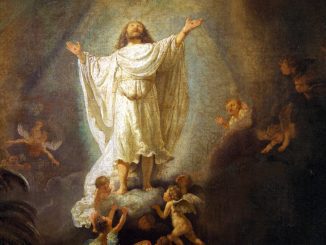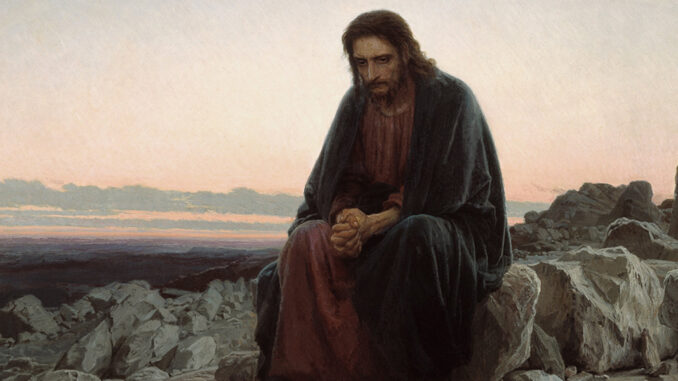
“I urge you, brothers, in view of God’s mercy, to offer your bodies as living sacrifices, holy and pleasing to God — this is your spiritual act of worship.” Romans 12:1
We are taught to present our bodies, as a living sacrifice unto God. Ancient offerings were brought to the altar, and presented dead. But the Christian sacrifice is not to be presented dead — it is to be given to God alive. The life, instead of being consumed in a holocaust, or poured out in a bloody oblation, is to be given to God for service. Christ came to give life to his followers, to give life in abundance. This call to consecration is therefore a call to life at its best.
We talk a great deal about the love of Christ — but we can help the world to know what that love of Christ is, only when in our daily lives — we illustrate it and reproduce it. It is our great mission in life — to make Jesus Christ appear beautiful to others. It was said of an old minister who had retired from active service — that it was worth all his salary just to have him live in the town. His life was such a revealing of the life of Christ — that wherever he went, it was like the shining there of a soft, gentle light.
We are to present our bodies to God as living sacrifices. Living — not dead. To be dead is to have no more power to do anything. A little child once tried to explain what it was to be dead. Shown a bumblebee that was no longer living, he said simply, “Not going any more.” The child’s interpretation was true. To be dead is to be not going any more, to be without life or power. We are called to be living sacrifices.
One of the best rules for everyday life is to try always to be a little kinder than is necessary.
When we use the word sacrifice, we think first of the great sacrifice of Christ — which is both the model for all Christian life, and also its inspiration. Everything good and beautiful gets its motive from the life of Christ, which shone with the holiest spirit of sacrifice. We look at his six hours on the cross when we speak of Christ’s sacrifice, as if that were its one great act and expression. But the cross was not endured by Christ merely during those six hours on Calvary; it was in all his life, in every day and hour of it. Everything he did was in love, and love is always a living sacrifice. He was always denying himself.
We do not have to be crucified on pieces of wood to bear a cross. When you were patient under insult or kind to one who had spoken ill of you, you were making a living sacrifice. On all his days, Christ made his life sacrificial. On Calvary, he only wrote the word out in capitals!
Our sacrifices are transformed by the sacrifice of Christ and the discipline of life. The godly life is not the one that has known only ease, pleasure and self-indulgence. Iron ore, dug from the hills, is not yet ready to be used. The ore must be put through the glowing furnace where it is transformed into something of great value. The same is true of manhood.
Some of us are forever complaining about the hardness of duty. Will we never learn the secret, that all our blessings, our sweetest joys, our richest comforts — come out of the very things that we so chafe and fret over?
We are called to present our bodies as living sacrifices to God. The sacrifices are not to be made, however, for their own sake. This is the law of life in Christ. This is one of the ways Christ is saving the world.
Watkinson tells of a London auction where military badges of honor were sold — medals earned by courage and sacrifice. Bought and worn by another, they would have been only tawdry tinsel.
Other people’s living sacrifices can bring no honor for us. They must be our own; the honors must be won by our own courage, faith and sacrifice. Some people like others to make the sacrifices for them — and then let them get the honor. A great humorist in the days of the Civil War used to talk of how many of his relatives he had given to his country’s service. Some Christian people like to urge and inspire others to make sacrifices, to give and suffer — while they do nothing of the kind themselves! But we never can have other people’s badges of sacrifice or decorations of honor pinned upon us. You must present your own body as a living sacrifice to God — your own, not another’s. You must bear the cross in your own life.
J. R. Miller (1840-1912) was a pastor and former editorial superintendent of the Presbyterian Board of Publication from 1880 to 1911. His works are now in the public domain. This is an edited version of his original.