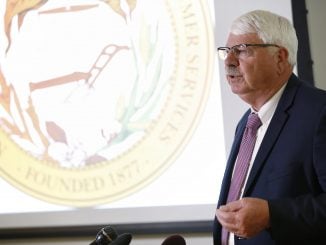
RALEIGH — The North Carolina Office of the State Auditor released a “comprehensive, data-driven performance audit” on long-term vacancies and related lapsed salaries in state agencies.
“Long-term vacancies muddy the waters of government expenditures,” State Auditor Dave Boliek said in a press release. “In some agencies, you have tax dollars meant to go to a person serving a valuable state need, but instead that spot sits empty for years and the money goes elsewhere.
“This first government efficiency report provides lawmakers and the public with needed transparency, and valuable data to make strategic, fiscally responsible decisions for North Carolina’s future. It includes several different options to improve government efficiency, from cuts to job vacancies, to increases in areas where additional resources may be necessary.”
The current audit follows a November report on vacant positions at the North Carolina Department of Health and Human Services.
“According to information submitted to OSA’s Division of Accountability, Value, and Efficiency (DAVE), along with data accessed by the OSA team, there were 8,846 long-term vacancies across 46 of North Carolina’s state agencies as of August 6, 2025. These positions have generated $1.04 billion in lapsed salary,” according to a press release from the Office of the State Auditor (OSA).
The OSA listed five agencies with the highest long-term vacancies of six months or more:
- Health and Human Services: 3,074 vacancies, $375 million in lapsed salary
- Adult Corrections: 2,817 vacancies, $228.6 million in lapsed salary
- Transportation: 838 vacancies, $78.6 million in lapsed salary
- Commerce: 684 vacancies, $226.1 million in lapsed salary
Lapsed salary is the money saved when a position stays vacant. The Office of State Budget and Management define it as unexpended salary funds during the vacancy period. Long-term vacant positions are funded through state appropriations, agency receipts and federal grants.
While agencies do use some lapsed salary funds, the $1.04 billion total cited by the OSA doesn’t necessarily reflect actual dollars available for other purposes or future savings if vacancies were filled.
Potential cost savings from eliminating long-term vacancies were a key item identified by the audit.
Cutting positions vacant for five years or more would eliminate 140 jobs and save $1.9 million in state funds, plus free up $4.5 million in receipts. Eliminating positions vacant for one year or more would cut 4,514 jobs and save $138 million in state funds, plus free up $79 million in receipts.
The audit also proposed eliminating positions vacant for three or more years while protecting critical roles like correctional officers, nurses, youth counselors and State Highway Patrol positions, which the audit says would save $11.2 million in state funds that could be redirected to those positions, taxpayers or other priorities.
Other key recommendations include better vacancy tracking and aligning agency budgets with actual needs. Before releasing the report, DAVE created an online dashboard showing long-term vacancies by agency and their lapsed salary amounts.
In addition to the lapsed salary and vacancies audit, the OSA also reported the North Carolina State Department of Transportation (NCDOT) had complied with its spending plan for fiscal year 2025, spending $8.23 billion out of a planned spending amount of $8.29 billion.
The NCDOT report said that pperations and maintenance expenditures “exceeded the forecast by $26 million (0.9%),” but the total was “within the forecast.” The report indicated that NCDOT went over the forecasted amounts “primarily due to costs associated with the Hurricane Helene disaster response.”
In the past, NCDOT had encountered issues with staying within its budget, and an audit conducted in 2019 showed the agency overspent by $742 million. However, this is the fourth year in a row an audit has shown the NCDOT has stayed within its spending plan.