
Dec. 25
1066: William the Conqueror was crowned King of England.
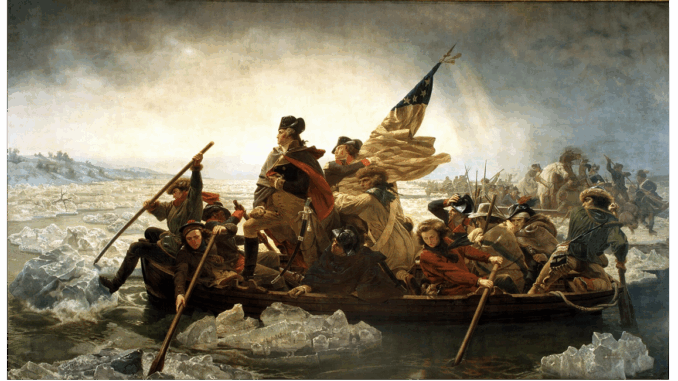
1776: Gen. George Washington and his troops crossed the Delaware River for a surprise attack against Hessian forces at Trenton, New Jersey, during the American Revolutionary War.
1818: “Silent Night (Stille Nacht)” was publicly performed for the first time during the Christmas Midnight Mass at the Church of St. Nikolaus in Oberndorf, Austria.
Dec. 26
1908: Jack Johnson became the first black boxer to win the world heavyweight championship as he defeated Canadian Tommy Burns in Sydney, Australia.
1941: During World War II, Winston Churchill became the first British prime minister to address a joint meeting of the U.S. Congress, just two weeks after the Japanese attack on Pearl Harbor that plunged the U.S. into the war.
1991: The USSR was formally dissolved through a declaration by the Supreme Soviet.
Dec. 27
1831: Naturalist Charles Darwin set out on a round-the-world voyage from Plymouth, England, aboard the HMS Beagle.
1904: James Barrie’s play “Peter Pan: The Boy Who Wouldn’t Grow Up” opened at the Duke of York’s Theatre in London.
1932: New York City’s Radio City Music Hall opened to the public.
1985: American naturalist and conservationist Dian Fossey, 53, who had studied mountain gorillas in Africa for nearly 20 years, was found murdered in her cabin in Rwanda. No one was arrested for the crime.
Dec. 28
1895: The Lumiere brothers, Auguste and Louis, held the first public showing of their films in Paris.
1908: A major earthquake followed by a tsunami devastated the Italian cities of Messina and Reggio Calabria, killing at least 70,000 people.
1945: Congress officially recognized the Pledge of Allegiance.
Dec. 29
1170: Thomas Becket, the archbishop of Canterbury, was killed inside Canterbury Cathedral by knights loyal to King Henry II.
1890: The Wounded Knee massacre took place in South Dakota, where more than 250 Lakota people were killed by U.S. troops sent to disarm them.
1940: During World War II, the German Luftwaffe dropped incendiary bombs on London, triggering what became known as the Second Great Fire of London.
Dec. 30
1860: 10 days after South Carolina seceded from the Union, the state militia seized the United States Army arsenal in Charleston.
1922: The Union of Soviet Socialist Republics (USSR) officially came into existence.
2006: Former Iraqi President Saddam Hussein was executed by hanging after being convicted of crimes against humanity by the Iraqi High Tribunal.
2015: Actor and comedian Bill Cosby was charged with drugging and sexually assaulting a woman at his suburban Philadelphia home in 2004.
Dec. 31
1879: Thomas Edison first demonstrated his electric incandescent lights for the public by illuminating some 100 bulbs in and around his laboratory in Menlo Park, New Jersey. 1904: New York’s Times Square saw its first New Year’s Eve celebration, with an estimated 200,000 people in attendance.
1995: The syndicated comic strip “Calvin and Hobbes,” created by Bill Watterson, came to an end after a 10-year run.

