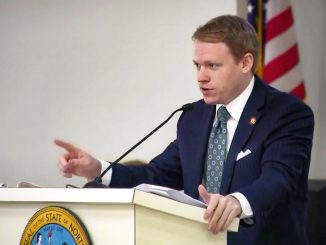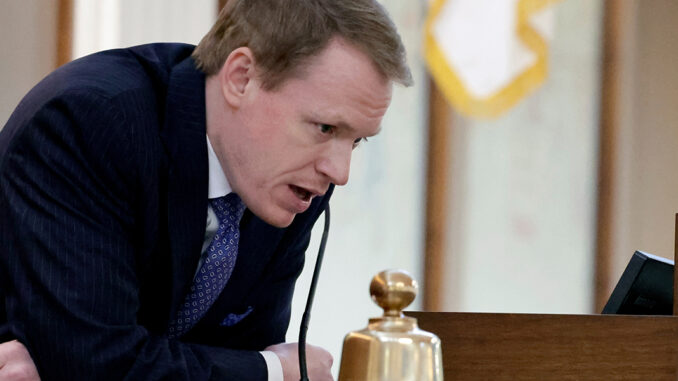
RALEIGH — North Carolina House Speaker Destin Hall (R-Granite Falls) has formed a new House Select Committee to examine property tax reform.
“For too long, local governments have steadily increased property taxes,” Hall said in a post on X. “Enough is enough. The House is focused on providing meaningful relief for hardworking North Carolinians.”
According to the Committee on Property Tax Reduction and Reform’s formation document, members will “study options to reduce the property tax burden on taxpayers in North Carolina.”
The committee will also look at reforms that “provide property tax relief to taxpayers while balancing potential impacts on local government revenues.”
The new 23-member committee is made up of 15 Republicans and eight Democrats, and it will be co-chaired by Reps. Julia Howard (R-Davie), Mitchell Setzer (R-Catawba), Erin Paré (R-Wake).
Vice chairs include Reps. Brian Echevarria (R-Cabarrus) and Neal Jackson (R-Moore).
The 10 remaining Republican Committee members are Reps. Jonathan Almond (R-Cabarrus), Tricia Cotham (R-Mecklenburg), Keith Kidwell (R-Beaufort), Larry Potts (R-Davidson), Dennis Riddell (R-Alamance), Mike Schietzelt (R-Wake), Harry Warren (R-Rowan), Sam Watford (R-Davidson), Diane Wheatley (R-Cumberland) and Jeff Zenger (R-Forsyth).
The eight Democratic members are Reps. Eric Ager (D-Buncombe), Becky Carney (D-Mecklenburg), Maria Cervania (D-Wake), Carla Cunningham (D-Mecklenburg), Frances Jackson (D-Cumberland), Abe Jones (D-Wake), Nasif Majeed (D-Mecklenburg) and Brian Turner (D-Buncombe).
Six areas of interest to be examined by the committee include:
• Review existing property tax relief programs currently available to North Carolina homeowners to determine whether those programs should be modified or expanded.
• Consider mechanisms to expand property tax relief to homeowners more broadly, including adjusting the frequency of revaluations, implementing methods to minimize the impact of future revaluations on homeowners, or providing homeowners with alternative payment plans.
• Examine the uniformity requirement in Article V, Section 2 of the North Carolina Constitution and evaluate whether to amend the North Carolina Constitution to allow counties to implement property tax reductions and reforms.
• Analyze potential impacts and options to address local government revenue reductions, including reimbursement mechanisms and additional revenue-generating authority.
• Consider factors associated with increasing property tax assessments on taxpayers, including reviewing local government debt and spending levels.
• Consult organizations and entities with expertise in local government operations, financing and real property valuation
The committee’s findings and proposed legislation are to be presented before the convening of the legislature’s 2026 regular session.