
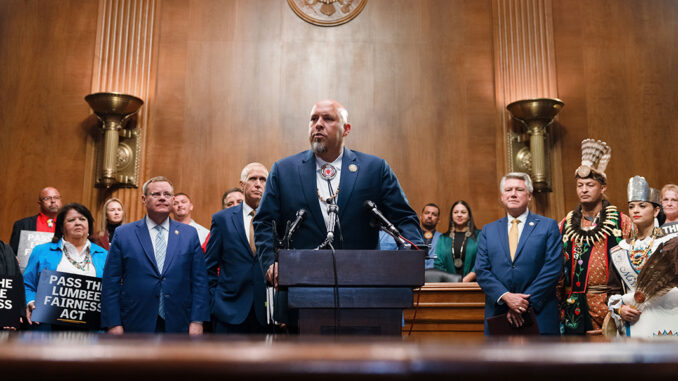
RALEIGH — Differing opinions on full recognition of North Carolina’s Lumbee Indian Tribe were the subject of a U.S. Senate hearing earlier this month. The 55,000-member Lumbee Tribe spans Robeson, Hoke, Cumberland and Scotland counties.
Full recognition of the Lumbee Tribe was a campaign promise made by President Donald Trump. Upon taking office, Trump issued a presidential memorandum supporting full federal recognition of the tribe and directing the secretary of the Interior to create a plan to that end.
The U.S. Senate Committee on Indian Affairs heard testimony Nov. 5 from witnesses on both sides of the case being made for passage of the Lumbee Fairness Act, which would give the tribe full federal benefits recognition, including funding support.
Committee Chair Sen. Lisa Murkowski (R-Alaska) noted that Department of Interior officials declined to testify at the hearing due to the government shutdown but would be submitting written testimony for the record.
North Carolina Republican Sen. Thom Tillis said there is strong bipartisan support for the Lumbee Fairness Act he is sponsoring.
“This issue has come before Congress many times over the decades, but never with this level of unity and support,” Tillis said. “These days, it’s rare to see Republicans and Democrats come together on anything. But when it comes to Lumbee recognition, the support is overwhelming, and it’s bipartisan.
“We’re talking about support from President Donald J. Trump, President (Joe) Biden, Vice President JD Vance, former Vice President Kamala Harris, Gov. Josh Stein, the North Carolina General Assembly and nearly every member of our state’s congressional delegation,” Tillis said.
Tillis noted two dozen members from both parties co-sponsored the Lumbee Fairness Act, “including Sen. (Brian) Schatz and Sen. (Markwayne) Mullin, who sit together on this very committee.”
“And maybe most remarkable, more than 235 federally recognized tribes have stood with the Lumbee people, including the Alaska Federation of Natives, representing 186 tribes and corporations,” said Tillis.
Following the hearing, Tillis held a press conference in support of the act with Sen. Ted Budd, Reps. Richard Hudson, Tim Moore and Mark Harris, and Lumbee Tribal Chairman John Lowery.
An identical act was rolled into the National Defense Authorization Act (NDAA) passed by the House this year. The Senate passed its own version of the NDAA without including the act.
Among the other witnesses giving testimony in favor of the act being approved were Lowery and Lumbee Tribe attorney Arlinda Locklear.
Lowery was recently installed in the North Carolina House to replace his brother, Jarrod, who left the legislature on Oct. 1 to take a role in the U.S. Bureau of Indian Affairs.
Lowery said the Lumbees have had “at least nine hearings” before the committee and have received “strong support” for the tribe’s recognition. He also said he was confident Congress would amend the Lumbee Act of 1956, a “flawed law” preventing Lumbee recognition that was passed by Congress during the termination era of federal policies for Indian tribes.
“Today, I stand before you as a leader of a people who have never been afraid to fight, to stand our ground and resist oppression,” Lowery said after recounting his family’s history in the war for independence. “When we are pushed, we push back.”
Lowery named Lumbee members and supporters who passed away, telling the committee, “Do not let us bury another Lumbee or lose another ally in this fight for justice.”
Citing past legislation, Lockler told the committee, “All of those bills have failed, and let me tell you that has been a heartbreaking process for the Lumbee people.”
Those appearing in opposition to the act included Michell Hicks, principal chief of the Eastern Band of Cherokee Indians, and Ben Barnes, chief of the Shawnee Tribe and chair of the tribes of Oklahoma.
Both Hicks and Barnes believe the Lumbees should follow an administrative process through the Office of Federal Acknowledgement to receive full federal recognition rather than an act of Congress. Most of the committee seemed to disagree, underscoring that Congress has the authority to give the Lumbees full recognition.
Hicks and Barnes also questioned the history of the tribe, particularly mentioning the various name changes and tribal affiliations claimed by the Lumbees in the past.
Hicks said the Lumbees “never demonstrated descent from any known historical tribe” and said past name changes show “a pattern of shifting due to circumstance.”
Mullin (R-Okla.), who is the only member of the Senate of Native American descent, asked Hicks if the Lumbees are native, to which Hicks replied, “I think there is potentially native descent; doesn’t make them a tribe.”
When Mullins asked Hicks why North Carolina recognized the Lumbees in 1985, Hicks said, “North Carolina has different standards” and that he wasn’t sure the Lumbees would pass the state’s standards in the present day.
Mullin accused Hicks of “the cost” being the reason he opposes full recognition of the Lumbees, telling Hicks if that’s the reason, maybe Congress shouldn’t recognize any more tribes.
“I hate it when we fight amongst ourselves,” Mullin told Hicks. “Because we should all be in the same boat rowing in the same direction.”
Following Mullin, Schatz rebutted the arguments made by Hicks and Barnes, saying that while cost is a “valid concern,” it was “just not a good reason not to grant recognition.”
Murkowski also questioned Hicks about his claim the Lumbee should go through administrative channels instead of Congress.
“(In) your written testimony, you claim that the Lumbee situation is uniquely beyond Congress’ capacity to understand and evaluate,” Murkowski said to Hicks before asking him to explain why this case is different from other tribes that gained recognition through Congress.
Hicks responded that researchers found “clear gaps” in Lumbee history that need “expertise” to resolve, which congressional staff lack.
The hearing closed with no indication of when or if a vote would be held to advance the act.


