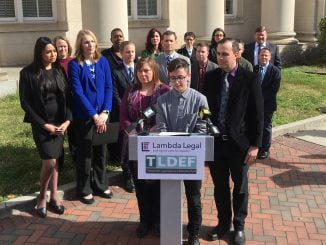
RALEIGH — Following a U.S. Court of Appeals for the 4th Circuit ruling, the North Carolina State Health Plan will reinstate exclusion of coverage of “transition-related treatments.”
The appeals court’s decision in Kadel v. Folwell vacates a district court’s earlier ruling and reactivates the exclusion of such treatments by the State Health Plan (SHP). The exclusions had been in place since the 1990s and were listed among the plan’s annual list of excluded items even though they were inactive.
“Generally, the exclusion does not prevent the treatment of any infection, injury, disease, disorder or complication that has been caused by or exacerbated by the performance of gender transition medical or pharmaceutical procedures,” State Treasurer Brad Briner’s office, which oversees the SHP, said in a press release.
“Additionally, in 2021, the Plan’s Board of Trustees affirmed continued coverage for psychological assessment and psychotherapy treatment in conjunction with a diagnosis of or connected to gender dysphoria,” Briner’s press release reads. “The reimplemented benefit exclusion does not exclude psychological assessment and psychotherapy treatment in these cases.”
The SHP is now working with the state’s third-party administrator and health care providers to “make sure this decision is fully communicated to all members affected by the reinstatement.”
Exclusion of transition treatments had been blocked until 2022, when U.S. District Judge Loretta Biggs issued an injunction requiring the SHP to provide coverage for those treatments.
After Biggs’ 2022 ruling favoring the plaintiffs, an appeal followed, and the 4th Circuit Court of Appeals affirmed the decision in 2024 by an 8-6 vote. However, that ruling was appealed again to the U.S. Supreme Court, during which an amicus brief was filed by 23 state attorneys general in support of the SHP’s case.
In June 2025, the U.S. Supreme Court vacated the 4th Circuit’s ruling and instructed that court to reconsider the case in light of its decision in United States v. Skrmetti, a Tennessee case in which the high court upheld a state law banning gender transition treatments for teens, such as puberty blockers and hormone therapy.
Briner had previously framed the case as a matter of whether elected representatives or plaintiffs should determine health plan coverage and praised the U.S. Supreme Court’s ruling.
“Kadel v. Folwell has always been about one question. Do the people of North Carolina, through their elected representatives, get to ultimately manage the State Health Plan? Or can plaintiffs dictate what procedures we cover?” Briner said in a press statement following the ruling by the U.S. Supreme Court. “We are gratified that the Supreme Court has agreed with our strongly held belief in the State Health Plan Board of Trustees’ authority in this matter.”
Following the instructions from the U.S. Supreme Court, the 4th Circuit reconsidered the case and issued a Sept. 23 order vacating Biggs’ 2022 decision and remanding the case back to the district court for “further consideration in light of Skrmetti.”
Court records show the case is currently unassigned at the district court level, with earlier filings in August indicating Biggs is no longer handling the case.