We sometimes forget that God has anything to do with the small events of our everyday lives. People seem to live unaware of God and uninfluenced by Him. They follow their own judgment, make their own decisions and rarely sense divine intervention.
Yet nothing is truer than that God is always moving in our lives — in every life — even in the smallest affairs. He may not audibly tell us what to do. Yet He guides us in our choices, cooperates with us in carrying them out and influences us often without our awareness.
We may plan a journey by one route and God leads us another way. Along the way we may meet someone who needs us, and a simple kindness changes our life — or theirs — forever. All of life is full of God. Christ’s teachings make this clear. He tells us that our heavenly Father feeds the birds. Two sparrows are sold for a penny, yet not one is forgotten by God. “You are of more value than many sparrows.” Matthew 10:31
“The very hairs of your head are all numbered.” This does not necessarily mean He counts our hairs, but that He is concerned with even the smallest circumstances of our lives. Nothing is too trivial for His notice.
In Second Kings, we he hear of Elisha’s servant who awoke and saw an enemy army surrounding the city. Alarmed, he cried, “Alas, my master! What shall we do?” Elisha answered, “Fear not; for those who are with us are more than those who are with them.” He prayed, and the servant’s eyes were opened. “Behold, the mountain was full of horses and chariots of fire round about Elisha.”
This was not a dream — it was a glimpse of reality. If we could see the invisible world, we would discover that every Godly life is divinely protected and every step divinely ordered. This is what we call divine providence. Around every life the angels encamp.
Not only is God with us — He works with us. We may think we have accomplished something, when in truth, God has done it through us. A man was driving a pair of horses while his young son proudly held the reins. The boy believed he was in control — until he felt the reins pull firmly through his hands. His father’s hands had been guiding all along. “I thought I was driving, father — but I am not!” Just so, God’s hands are in back of ours.
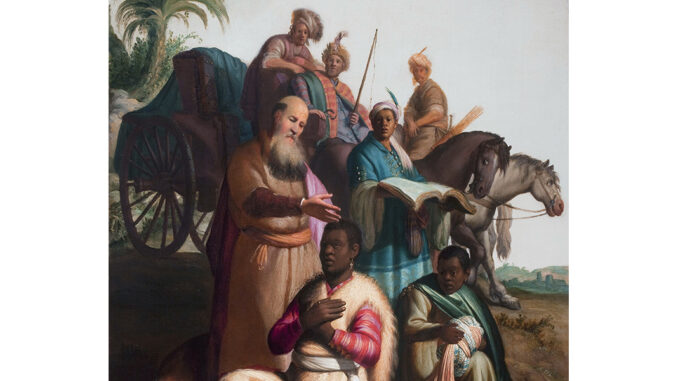
We see this divine activity in Acts, when Philip was preaching in Samaria. Suddenly the Spirit directed him to a desert road. He did not question — “He arose and went.” Eventually, he saw a chariot and felt compelled to approach it. Inside was a man of high rank from Ethiopia reading Scripture. Philip asked if he understood what he read, and the man admitted he did not. Philip sat beside him and explained how it revealed Christ and the man was eventually baptized.
This meeting in the desert was not accidental — it was divinely arranged. Usually we do not see God’s hand so plainly, but He is always present. We may go out on a simple journey, thinking it is only for business or pleasure, but God may have a purpose in it. There are no accidental meetings. God arranges that certain people cross our path at a specific moment.
They may be discouraged, and we can offer cheer. They may carry a burden — not one we can remove, but one we can help them bear. These are sacred errands. We are sent providentially to be present in the moment of need.
Before Jesus met the woman at the well, we are told He “must needs pass through Samaria.” Wearied, He sat down to rest. It seemed accidental. Then the woman came to draw water — God had sent her to One who could change her life. Jesus did not fail, though weary. He could have turned her away, but He saw it as a divine opportunity.
He might have said he was too tired to talk to this woman. That is what some Christian people say when, providentially, a human need meets them. “I have put on my house-coat and my slippers, and I cannot go out again tonight.” But we should never fail God when He brings some piece of love’s duty to our hand.
Life is full of God. Even on our lightest days, He gives us sacred tasks. We may ride with a stranger on a train or meet someone downtown — and the opportunity arises to say a word that changes a life. Even chance meetings are providential.
We do not begin to understand how full of God our lives are. The person beside you may need the very words on your lips — but idle words may crowd them out. You may never see them again.
If sickness comes, you “must needs” pass through it. It is not an empty experience. In the sickroom are lessons, duties, and blessings. If sorrow comes, it too is sacred. Even death is a “must needs” path — divinely chosen, and full of God’s presence and love.
J. R. Miller (1840-1912) was a pastor and former editorial superintendent of the Presbyterian Board of Publication from 1880 to 1911. His works are now in the public domain. This is an edited version of his original.