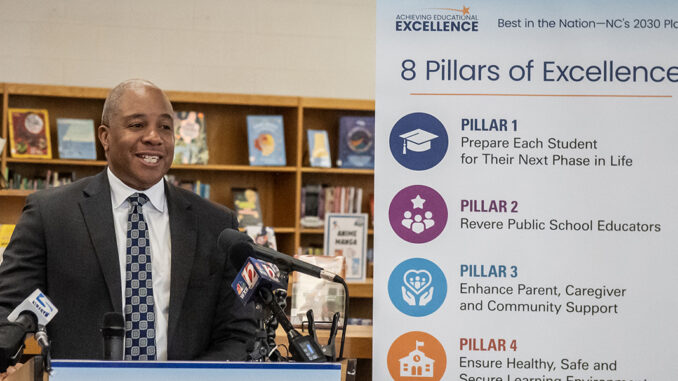
RALEIGH — North Carolina State Superintendent Mo Green unveiled an ambitious five-year strategic plan aimed at transforming its public education system into the nation’s best by 2030 during a press event on Aug. 20 at the Centennial Campus Center for Innovation Magnet Middle School in Wake County.
The event kicked off with a tour of the school led by school Principal Jesse Gore. There was also a student dance performance.
“The goal is to be the best public schools in the nation,” Green said. “And to declare that, absolutely it is visionary.”
Green was joined by N.C. State Board of Education Chair Eric Davis, Wake County Superintendent Robert Taylor, Wake County School Board Chair Chris Heagarty and 2024 Principal of the Year Beckie Spears.
Rep. Cynthia Ball (D-Wake) and former Rep. Jeffrey Elmore (R-Wilkes) also attended. Gov. Josh Stein was unable to attend due to responsibilities dealing with Hurricane Erin.
The “Achieving Educational Excellence” initiative represents the first collaborative effort between the State Board of Education and the state superintendent, developed through extensive stakeholder engagement including regional “Mo wants to know” listening sessions and school visits across the state.
“This plan belongs to all North Carolinians,” Green said while describing the plan’s “call to action.” He added this plan “is for the entire state,” and everyone needs to “do their part.”
It centers on guaranteeing every student’s right to an excellent public education and making public schools as the preferred choice for families statewide. Green said the plan will need “strategic financial investments” and mentioned discussions with lawmakers about the support the plan might need.
A primary objective involves increasing public school enrollment from the current 84% to 89% of school-aged children by 2030, demonstrating confidence in the system’s ability to attract and retain students through improved quality and outcomes.
The plan is rooted in eight pillars: preparing each student for their next phase in life; revering public school educators; enhancing parent, caregiver and community support; ensuring healthy, safe and secure learning environments; optimizing operational excellence; leading transformative change; celebrating the excellence in public education; and galvanizing champions to fully invest in and support public education.
The plan establishes specific goals for 2030 and more than 100 action items that will be tracked and for which Green said results would be made public at state board of education meetings on a quarterly basis.
“We want to be upfront and honest,” Green said about the progress of the plan’s action items.
The four-year graduation rate target increases from 86.9% to 92%, while ACT composite scores aim to rise from 18.5 to 20.
Advanced Placement participation among high school students should expand from 21.5% to 30%, and Career Technical Education engagement across all K-12 students is projected to grow from 36.1% to 41%.
Additionally, the state seeks national leadership in reading and mathematics scores on the National Assessment of Educational Progress, with all metrics tracked through disaggregated data to ensure equitable progress across demographic groups.
Beyond academic achievement, the plan emphasizes character education through increased recognition as National Schools of Character, comprehensive character education program implementation and expanded service-learning opportunities.
“We appreciate and understand that our students are more than test measures,” Greene said, underscoring the plan being student-centric and educator focused.
The Office of Strategic Planning will coordinate efforts in achieving the plan’s goals alongside a Monitoring and Accountability Committee providing quarterly progress reports.
Green said the plan functions as a “living document,” subject to annual reviews and adaptations based on emerging needs and changing circumstances.
Some actions are already underway, such as the migration to Infinite Campus, the new school and student data system. Green also mentioned a $25 million Golden LEAF Foundation investment targeting math instruction in rural middle schools and the NC College Connect, which guarantees college admission for North Carolina students who have a GPA of 2.8 or higher.
Additionally, Green said the plan seeks to create an endowment for two years of free tuition for post-secondary North Carolinian students.
More complex initiatives, such as system modernization and comprehensive program rollouts, will be phased in over the five-year period.