RALEIGH — House Bill 442, introduced in April, aimed to extend the recreational flounder fishing season to six weeks and establish a year-round red snapper season with catch limits.
The bill passed the House in May with bipartisan support and was sent to the Senate. After that, the bill’s focus shifted dramatically when the Senate Committee on Agriculture, Energy, and Environment met June 17.
During that meeting, Sen. David Craven (R-Randolph) proposed a committee substitute with a ban on shrimp trawling in all inshore waters, including sounds, estuaries, rivers and within a half mile of the Atlantic shoreline. The change, which would go into effect Dec.1, proposed making it a Class A1 misdemeanor for violating the bill’s ban.
Environmental groups like the North Carolina Wildlife Federation and North Carolina Wildlife Resources Commission supported the change, citing rates of bycatch of juvenile fish and various marine habitat damage.
The shrimp industry, including the North Carolina Fisheries Association and Southern Shrimp Alliance, opposed the ban. They argued that 70-80% of shrimp come from inshore waters, and many small boats can’t operate offshore. Also cited were existing regulations addressing environmental concerns, like weekend trawling bans and nursery areas closed since 1978.
The Senate’s changes were added without prior notice to House sponsors or the shrimp industry. The Senate passed the amended bill June 19 with a 39-4 vote.
Coastal area Sens. Michael Lazzara (R-Onslow) and Norman Sanderson (R-Pamlico) voted against it in committee. Lazzara and Sen. Bobby Hanig (R-Currituck), who also opposed the change, were not present at the Senate vote sending the measure to the House.
Rep. Keith Kidwell (R-Beaufort) first sounded the alarm about the changes in a June 18 Facebook post.
“An all-out crustacean and fish fight broke out Tuesday in the Senate Agriculture committee, thanks to a move by some of the chamber’s Republicans to ban shrimp trawling anywhere inside a half mile of North Carolina’s Atlantic shoreline,” he wrote.
In response to the Senate altering the bill, members of the House altered House Bill 441 to provide transition payments to shrimpers until October 2028 if House Bill 442 were to advance.
From June 20-24, opposition and tensions grew.
Shrimpers, coastal communities and groups like North Carolina Watermen United criticized the Senate’s version of the bill being introduced without being consulted.
Anthony Street, a former candidate for state auditor from Brunswick County, was arrested for making death threats against Sen. Bill Rabon (R-Brunswick), who supported the ban.
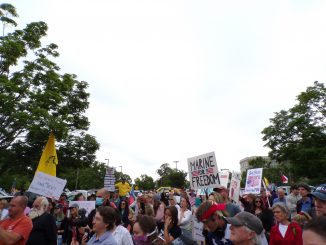
On June 24, shrimpers, fishermen and others who opposed the measure held a protest outside the North Carolina General Assembly in Raleigh.
It was reported by ABC11 and other outlets that NC Catch and North Carolina Watermen Unite organized the protest, with attendees wearing “No Trawl Ban” shirts. Trucks with signage on them also circled the legislature.
Some of the groups involved also apparently met with lawmakers to demand the amendment’s removal, citing fiscal impacts on the shrimp industry. Research in 2021 by NC State’s NC Sea Grant reported that the “wild-caught seafood industry contributes nearly $300 million in value and 5,500 jobs to the state’s economy.”
According to a 2024 report by the N.C. Division of Marine Fisheries, the combined types of commercial shrimp caught off the state’s coast was worth more than $14.1 million in 2023, a steep drop from the $24.68 million reported in 2021.
The North Carolina Local Food Council said 75% of North Carolina shrimp are harvested in internal waters, while 25% come from the Atlantic Ocean.
The North Carolina Wildlife Federation cited data showing an inshore trawling bycatch kill rate of juvenile fish of four pounds per every pound of shrimp. Shrimp industry groups and fishermen countered, claiming that bycatch includes species that don’t affect game fish populations.
On June 25, House Republicans refused to advance the Senate’s amended bill, effectively killing the measure for the 2025 long session.
The House’s refusal to advance the Senate’s changes preserved the status quo for shrimpers, but with the bill now dead, those who fish recreationally were left without the originally proposed fishing season expansions.
Freelance journalist Bryan Anderson captured Kidwell’s remarks after the House killed the bill, with Kidwell stating, “It’s dead. Like I said, I put a stake in its heart. I’m thrilled. I’m gonna go have a shrimp dinner tonight.”
Kidwell and Hanig warned that the bill could be reintroduced in future sessions.
Following the bill’s demise, Rep. Frank Iler (R-Brunswick) issued a lengthy Facebook post clarifying misconceptions on social media about his involvement in House Bill 442 and House Bill 441.
Iler was an original primary sponsor of both bills but withdrew his name after the Senate’s actions. He wrote that both bills passed the House and “were sent to the Senate with the intention of passing as is,” and that it was “fake news” that he had any idea what the Senate was doing.
“However, the Senate hijacked both bills with absolutely no notice to me as the original primary bill sponsor,” Iler wrote. “I was blindsided by my own Senator in committee as I arrived to present HB 442 in Senate Agriculture, Energy and Environment last week on June 17th.”
Iler thanked the bill’s original sponsors, Kidwell and Democratic Rep. Pricey Harrison (Guilford), and singled out Hanig for his action in a “truly David and Goliath story.”