RALEIGH — Members of a teacher’s association in North Carolina are questioning the transparency and consent process involved in a merger with a national teacher’s union.
Last fall, the board of Professional Educators of North Carolina (PENC) unanimously approved an affiliation with the American Federation of Teachers (AFT), a national labor union representing 1.8 million educators.
PENC rebranded as the American Federation of Professional Educators in North Carolina (AFPENC), with the change announced Oct. 14, 2025, in Charlotte.
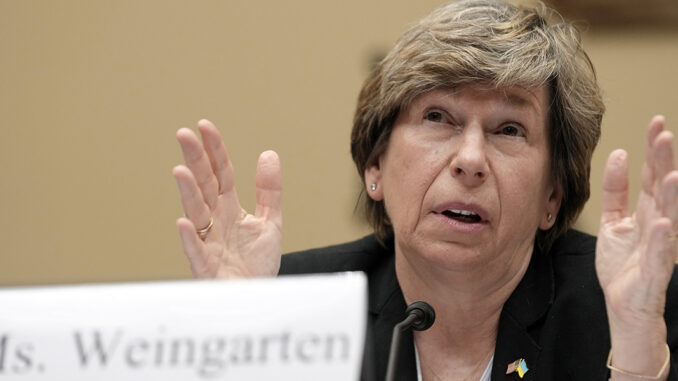
AFT President Randi Weingarten and AFPENC President Joanna Loftis signed the agreement, framing it as a “historic” move to amplify advocacy for teacher pay, working conditions and public education funding in a right-to-work state that prohibits collective bargaining and strikes.
Public statements from AFT and AFPENC describe the affiliation as the culmination of years of member-driven organizing, aimed at addressing declining membership and limited statewide influence.
PENC had about 2,082 members in 2022-23, down nearly 4% year over year.
Benefits touted for the merger include enhanced resources like professional development, legal support, disaster relief, classroom tools and stronger lobbying efforts in Raleigh while emphasizing AFPENC’s continued autonomy as a North Carolina-focused entity governed by local educators.
However, internal pushback has highlighted concerns about the process’ legitimacy. Past PENC President Tim Barnsback has criticized the affiliation as lacking proper member consent.
“I got involved because leadership changes raised legitimate questions about governance and stability, and I believed members deserved clear answers so the organization could remain a strong advocate for public education in North Carolina,” Barnsback told North State Journal. “I support a strong, nonpartisan collective voice for teachers, but any affiliation needs to be handled transparently so it strengthens, rather than weakens, educators’ ability to defend public education in North Carolina.”
In formal emails starting Oct. 20, 2025, Barnsback requested key records: pre- and post-affiliation bylaws, board vote details (including quorum and motion), explanations of ratification requirements, full minutes, conflict-of-interest policies, the affiliation agreement, and the membership list to verify notice and participation.
Responses from leadership from AFTPENC officials, including Loftis, Office Administrator Catherine Coleman and Executive Director Donnell McLean, involved initial delays, partial fulfillment and some denials.
Officials asserted board authority under the state’s Nonprofit Corporation Act to enter affiliations without amending governing documents or triggering a member vote, deeming the action preliminary.
“I’m not trying to stop the affiliation,” said Barnsback. “My concern has always been about process and trust. If educators are going to stand together to protect public education in North Carolina, the organization representing them has to be transparent, accountable and member-driven.
“If the affiliation is done properly, with transparency, clear documentation and informed member consent, it has the potential to strengthen educators’ ability to push back against efforts that undermine public schools and teaching.”
A request for a membership list was rejected as unrelated, since officials asserted no member notice was required for board decisions. Barnsback argued this breached statutory transparency standards and fiduciary duties.
A Dec. 19, 2025, letter to members extended a Google Form feedback period and promised draft bylaw revisions for a January annual membership vote on amendments. The feedback form originally ran for three days in mid-December.
Critics view this as retroactive legitimization of a done deal, especially after the rebranding and public claims of finality.
Barnsback also noted the disabling of the internal member communication portal amid rising questions, limiting discussion.
“I’ve invested nearly 20 years in PENC as a member and served as board president during some of the organization’s most successful and influential years,” Barnsback said. “Watching it unravel because of mismanagement and poor legal and ethical practices has been heartbreaking, especially knowing how much it once meant to educators across North Carolina.”
As of Jan. 9, AFPENC’s website presents the affiliation as complete and positive, highlighting its legacy since 1979 and new AFT-backed strengths, with no public acknowledgment of disputes.
North State Journal reached out to AFPENC officials with several questions regarding voting processes, quorum of the board vote and the board’s authority to enter into the affiliation, as well as questions about member feedback and record transparency raised by Barnsback.
Loftis responded to North State Journal, offering a statement in email, but no detailed answers to the questions posed.
“The executive board of PENC (doing business as AFPENC) engaged in an affiliation with AFT with the general governing powers of the organization in pursuance with the PENC bylaws and North Carolina Nonprofit Corporation Act,” Loftis wrote in an email.
“All board decisions toward the affiliation were made unanimously at official board meetings where a quorum was present. Through the process AFPENC has remained compliant with all state statutes and remains in constant communication with our legal consult.
“The affiliation with AFT maintains PENC’s autonomy in governance and leadership. Membership will vote on amended bylaws and articles of incorporation wherein all proper notices will be sent to the general membership as required by our bylaws and state law.”
On Saturday, a virtual town hall was held for members regarding an upcoming vote on amendments to the organization’s Articles of Incorporation and Bylaws but also ostensibly to address PENC member issues with the merger.
Loftis, McLean and most board members were in attendance, as well as former Democratic State Superintendent candidate Jen Mangrum and current General Assembly House candidate Kelly Van Horn, who changed her party affiliation to Republican to challenge Rep. Tricia Cotham (R-Mecklenburg) in this year’s primary.
Attendees indicated to North State Journal that AFPENC leadership didn’t take objections seriously and that questions were deflected or left unanswered.
When members asked about dues increases, they were told the board said that was still undecided. Members were unhappy with that position, saying they were still being asked to vote yes on the merger and trust the board.
Members also asked about union activity in North Carolina, citing an AFT article that says AFPENC has joined picket lines, participated in national political protests and engaged in activities that have never occurred in North Carolina.
Members were then told PENC would be “strengthened by a national union.” Certain union activity, like organized strikes, is illegal for public employees in North Carolina.
The AFT article also says that AFPENC conducted a book giveaway for students in North Carolina that apparently never happened. When asked about it, Loftis said that a book giveaway was planned but admitted it has not yet taken place.
AFT has also sent newsletters containing content focused on AFT President Weingarten’s statements on anti-Immigration and Customs Enforcement protests.
AFPENC’s annual board meeting is scheduled for Jan. 31 via video conference, at which time the board will vote on the amendment changes presented at the previous Saturday’s meeting.